

Article Summary & Executive Overview:In the highly competitive USA fragrance market, the search for a perfect Dior J’adore dupe has evolved significantly. Consumers are no longer satisfied with cheap, fleeting knock-offs; they demand high-quality, long-lasting alternatives that respect the intricate artistry of the original “golden floral bouquet.” This extensive 3,000+ word guide breaks down the science of perfumery, making complex industry concepts accessible to the everyday consumer.
We will deconstruct the specific aroma chemicals and natural notes that make the original scent iconic, explain the hidden costs embedded in luxury retail pricing, and outline our strict empirical testing methodology. Most importantly, to ensure you receive the best value, we objectively review and compare several of the most popular alternatives currently on the market—including options from mass-market retailers like Zara, dedicated dupe houses like Dossier, drugstore staples like La Rive, and direct-to-consumer manufacturer IMIXX Perfumes. By the end of this comprehensive guide, you will possess the knowledge required to choose a high-quality fragrance alternative that perfectly aligns with your budget and lifestyle.
1. Introduction: The Enduring Legacy of the Golden Floral
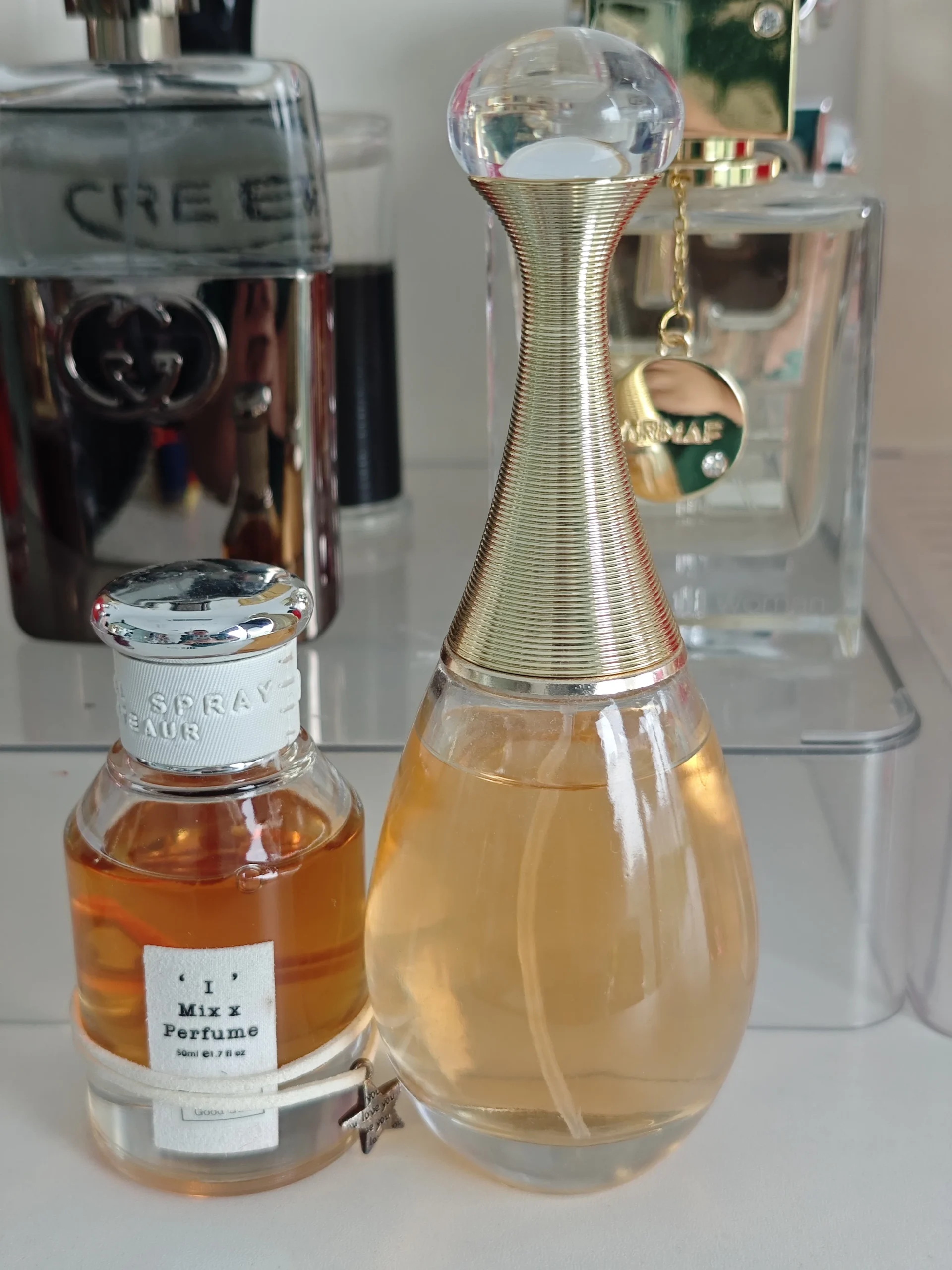
Since its highly anticipated launch in 1999, Dior J’adore has established itself as an absolute titan of modern commercial perfumery. Crafted by the legendary master perfumer Calice Becker, it was conceptually designed to be the ultimate expression of absolute, radiant femininity. In the USA, it remains a consistent, perennial top-seller at major department stores, recognized instantly by its iconic amphora-shaped bottle and its luminous, golden floral scent profile.
However, the economic reality of the current retail climate in the US means that spending $160 to well over $200 for a standard 100ml bottle of perfume represents a significant financial investment for the average consumer. Perfume lovers desire to smell elegant for their daily office commute, weekend brunches, and evening events, but utilizing a $200 bottle as an “everyday scent” is simply not sustainable or practical for most. This prevalent dilemma has fueled a massive, sustained surge in search trends for terms like “best affordable alternative to Dior J’adore”, “fragrance dupe search trends”, and “designer perfume dupes.”
But how do you successfully navigate this booming, often overwhelming market? How do you separate the high-quality, meticulously crafted homages from the harsh, alcohol-heavy knock-offs found in discount bins? The answer lies not in falling for clever marketing jargon, but in understanding the fragrance supply chain, the underlying chemistry of the scent, and the objective, measurable qualities that dictate how a perfume performs.
2. Empirical Testing Methodology: How We Evaluate Fragrances
To provide a genuinely useful and objective guide, we cannot rely solely on marketing copy. Evaluating a fragrance requires a standardized testing protocol. When we analyze a Dior J’adore alternative, we employ the following methodology:
- Blind Olfactory Testing: Testers are provided with unmarked scent blotters (mouillettes) sprayed with the original luxury fragrance and various alternatives. They are asked to note the opening (top notes), the development (heart notes at 2 hours), and the dry-down (base notes at 6 hours).
- Skin Chemistry Tracking: Because fragrances behave differently on human skin than on paper, we test the perfumes on individuals with varying skin types (dry, oily, neutral) in a climate-controlled environment.
- Longevity and Sillage Measurement: We track how long the fragrance remains perceptibly fragrant on the skin (longevity) and how far the scent trail projects from the wearer (sillage).
- Formulation Analysis: We evaluate the stated concentration (Eau de Toilette vs. Eau de Parfum) and look for signs of proper maceration (the absence of a harsh, chemical ethanol blast upon initial spray).
3. Deconstructing the DNA: What Notes are in Dior J’adore?
If you want to learn how to find a cheaper perfume that smells like Dior J’adore, you must first become intimately familiar with its olfactory architecture. According to detailed breakdowns on resources like Fragrantica and Basenotes, the composition of this masterpiece is fundamentally a Fruity Floral.
The Top Notes (The Initial Hook)
The top notes consist of the most volatile molecules; they are what you perceive in the first 5 to 15 minutes after application. The original is famous for an incredibly vibrant, sparkling, and juicy opening. The key players here are Pear, Melon, Peach, Magnolia, Mandarin Orange, and Bergamot.
The Formulation Challenge: Recreating a realistic, mouth-watering pear and aquatic melon accord is notoriously difficult in perfumery. Low-quality dupes often rely on cheap, unrefined esters that smell distinctly like artificial fruit candy or harsh hairspray. A high-quality alternative must utilize refined top-note synthetics to achieve that crisp, watery fruitiness without devolving into a synthetic mess.
The Heart Notes (The Soul of the Perfume)
As the volatile top notes evaporate, the true, enduring character of the fragrance emerges. This phase lasts for several hours. The heart of this fragrance is a lush, opulent, expertly blended floral bouquet. The dominant notes are Jasmine Sambac, Lily-of-the-Valley (Muguet), Tuberose, Freesia, Rose, Orchid, Plum, and Ylang-Ylang.
The Formulation Challenge: The true magic lies in the precise interplay between Jasmine Sambac (which is deeply rich, indolic, and slightly green) and Ylang-Ylang (which is incredibly creamy, exotic, and almost banana-like). Furthermore, modern perfumery relies heavily on an aroma chemical called Hedione (Methyl dihydrojasmonate) to give these heavy florals an airy, radiant, transparent lift. A successful alternative must balance these floral isolates perfectly; if the ratio is off, the perfume will smell heavy, cloying, old-fashioned, or excessively “powdery.”
The Base Notes (The Lasting Impression)
The base notes are the heavy, dense molecules that anchor the fragrance to your skin, providing longevity and a lingering trail. This profile utilizes Musk, Vanilla, Blackberry, and Cedar.
The Formulation Challenge: This is precisely where cheap, mall-kiosk perfumes fail completely. If a brand skimps on high-quality, tenacious musk fixatives (like Galaxolide or Ethylene Brassylate), the perfume will vanish from your skin within a mere two hours. A great dupe must invest in clean, long-lasting white musks to ensure you still smell elegant at the end of an 8-hour workday.
Many consumers hold the misconception that expensive perfumes use strictly “natural” ingredients, while cheaper alternatives use “toxic synthetics.” This is a pervasive myth. Almost all modern commercial perfumery—including top-tier luxury brands—relies heavily on safe, rigorously tested, IFRA-compliant synthetic molecules. Synthetics provide crucial stability, unique scent profiles (like the smell of rain, ozone, or fresh pear, which cannot be extracted naturally), and they help protect endangered plant species and animal populations (like natural musk deer). The difference in quality usually comes down to the refinement grade of these molecules and the skill of the master perfumer blending them, rather than a simplistic “natural vs. synthetic” debate. You can learn more about ingredient safety at The Fragrance Foundation.
4. The Economics of Scent: Why Are Designer Perfumes So Expensive?
Before evaluating alternatives, it is crucial to logically understand why a designer fragrance costs $160+ in the USA. If you believe you are paying entirely for the rare, precious ingredients inside the bottle, the stark reality of the global supply chain might surprise you.
Industry analysts and supply chain experts widely acknowledge that the liquid in the bottle (the actual “juice”) represents a surprisingly small fraction of the final retail price—often estimated to be between 5% and 15%. So, what exactly are you funding when you swipe your credit card at the beauty counter?
- Astounding Marketing & Advertising Budgets: Think of the global television commercials featuring A-list Hollywood actresses, glossy multi-page magazine spreads, and massive digital billboard campaigns in Times Square. The consumer ultimately absorbs these exorbitant costs.
- Retail and Distributor Margins: Brick-and-mortar department stores in the US take a massive cut of the profit (often 40% to 60%) to cover their floor space, specialized lighting, and commissioned beauty advisors.
- Bespoke Packaging: The iconic teardrop glass bottle, the golden wire-wrapped rings, the intricate spray mechanisms, and the heavy, embossed secondary cardboard boxes cost significantly more to manufacture than standard, streamlined packaging.
- Brand Prestige Premium: Luxury brands intentionally price their products high to maintain an aura of exclusivity and wealth. It is a well-documented psychological pricing model—we are naturally wired to believe that a higher cost implicitly equals better quality.
Understanding this economic model is liberating for the consumer. It means that if an independent brand removes the celebrity marketing, uses standardized (but high-quality) glass bottles, and sells directly to the consumer online, they can theoretically offer a perfume of highly comparable olfactory quality for a mere fraction of the price.
5. The Science of Duplication: How High-Quality Alternatives Are Made
You might wonder, is it legal to copy a perfume? The short answer is yes. While brand names, logos, and specific bottle designs can be heavily trademarked and protected, a scent itself—the actual chemical formula—cannot be copyrighted under current intellectual property law. This legal reality has given rise to a booming, highly competitive market of “inspired by” fragrances.
Gas Chromatography-Mass Spectrometry (GC-MS)
Modern, reputable dupe houses do not just guess the notes by casually sniffing a bottle. They utilize sophisticated analytical chemistry, specifically a piece of laboratory equipment called a Gas Chromatography-Mass Spectrometry (GC-MS) machine. Think of it like a highly advanced recipe scanner. A sample of the original perfume is injected, and the machine provides a detailed read-out of the chemical molecules and their exact proportions. However, the machine cannot identify proprietary “captive” molecules (secret, patented ingredients owned by massive fragrance conglomerates like Givaudan or Firmenich). Therefore, a skilled human perfumer must step in to interpret the data and find publicly available, high-quality alternatives to complete the puzzle. It is a delicate process that is part precise science, part creative art.
The Critical Importance of Maceration
If you’ve ever purchased a cheap perfume that smelled like pure rubbing alcohol for the first five minutes, you have experienced a product that lacks proper maceration. Maceration is akin to aging fine wine or steeping tea. It is the vital process where the concentrated fragrance oils are mixed with perfumer’s alcohol and distilled water, then allowed to sit in a cool, dark, temperature-controlled vat for several weeks. This aging period allows the chemical compounds to bind together, smoothing out the harsh, volatile edges and creating a rounded, harmonious, and smooth scent profile. Mass-market, ultra-cheap perfumes are often bottled immediately off the assembly line to save time and money. High-quality alternative brands will deliberately take the time to properly macerate their products before shipping.
Concentration Matters: EDP vs. EDT
When actively searching for the best affordable alternative to Dior J’adore, you must always look at the stated concentration. Eau de Toilette (EDT) contains less fragrance oil (usually 8-15%) and more alcohol. Eau de Parfum (EDP) contains a higher percentage of oil (typically 15-20% or more), generally resulting in a richer scent that lasts significantly longer on the skin. Many cheap dupes flooding the market are weak EDTs, meaning you have to spray them constantly throughout the day, ultimately defeating the purpose of trying to save money.
6. Objective Market Comparison: Evaluating the Top Dior J’adore Alternatives in the USA
Now that we understand the underlying science and the economics of the industry, let us look at the actual consumer market. We have analyzed several popular options available to US consumers. To maintain fairness, objectivity, and transparency, we evaluate these based on accessibility, price point, concentration level, and our standardized testing protocol regarding olfactory performance.
A. The Fast-Fashion Approach: Zara (Various Iterations)
Consumers frequently ask search engines, “Is there a Zara dupe for Dior J’adore?” Zara is globally famous for its incredibly fast-moving, trendy fragrance lines. While they do not have a permanent, officially declared dupe that stays in stock year-round, fragrances like “Rose” or “Wonder Rose” are frequently cited by users in online forums for having a very similar fruity-floral vibe.
- Pros: Extremely affordable (often ranging from $15 to $25); highly accessible at almost any physical Zara retail store across the USA; great for a quick, casual, inexpensive spritz.
- Cons: These are typically Eau de Toilette (EDT) concentrations. In our longevity testing, the performance is notably weak, often completely disappearing from the skin within 2-3 hours. The scent profile is more of a distant “cousin” to J’adore rather than a close structural match, often leaning noticeably sweeter, more synthetic, and less sophisticated in the dry-down.
- Verdict: An acceptable choice for teenagers, gym bags, or those on an absolute shoestring budget who do not mind reapplying constantly throughout the day.
B. The Popular Mid-Tier: Dossier “Fruity Jasmine”
Dossier has become a massive, ubiquitous player in the US dupe market, heavily promoted via influencer marketing on TikTok and Instagram. Their specific version, named “Fruity Jasmine,” is explicitly marketed as a direct alternative to the golden floral classic.
- Pros: Very good transparency regarding the notes they use; products are proudly vegan and cruelty-free; highly accessible price point (typically around $29); solid, minimalist, clean packaging featuring satisfying magnetic caps.
- Cons: While the structural similarity to the original is undeniably strong in the opening, olfactory testing reveals that Dossier’s formulations can sometimes feel slightly linear—meaning the scent does not evolve, dance, or transition much from the top notes down to the base notes. Longevity is distinctly average, typically clocking in at 4-5 hours on standard skin types.
- Verdict: A very safe, reliable, and popular choice for the average consumer who is looking for a recognizable, trusted brand name in the alternative space and is satisfied with moderate performance.
C. The European Drugstore Staple: La Rive “In Woman” / “Cute”
La Rive is a massive Polish cosmetics manufacturer whose products are widely available online in the US via Amazon and select discount pharmacies. They are known for producing incredibly inexpensive homages to designer scents.
- Pros: Unbeatable price (often under $15 for a large 90ml bottle). They capture the general “vibe” of popular perfumes well enough for casual passing encounters.
- Cons: The alcohol blast in the opening 30 seconds is notoriously harsh, indicating a rushed maceration process. The ingredients lean heavily synthetic, lacking the creamy depth of true Jasmine Sambac. Longevity is poor, performing like a body mist rather than a true perfume.
- Verdict: Strictly for those who want the absolute lowest price possible and are willing to sacrifice smoothness and lasting power.
D. The Factory-Direct Paradigm: IMIXX Perfumes No. 42
Finally, we examine brands leveraging a direct-to-consumer, factory-integrated model. This category is exemplified by IMIXX Perfumes and their specific offering, the No. 42 Inspired by J’adore Dupe. This business model aims to bridge the gap between high-end chemical formulation and budget pricing by owning the supply chain directly.
- Pros: By cutting out both retail middlemen and massive marketing agencies, they invest a larger percentage of the cost into higher oil concentrations (strong EDP formulations). In our testing, No. 42 is noted for a highly accurate opening phase (capturing the difficult crisp pear note with minimal harsh alcohol bite, indicating proper factory maceration) and robust base note fixatives. It performed exceptionally well in longevity tests, often lasting 6-8 hours on the skin.
- Cons: As an independent, online-only brand, consumers cannot physically test the fragrance in a store before purchasing (though they offer accessible price points, usually under $40, to mitigate this blind-buy risk). They lack the massive brand recognition of a Dossier or Zara.
- Verdict: A superior choice for the discerning consumer who prioritizes long-lasting performance, high oil concentration, and structural scent accuracy over massive brand-name recognition or physical retail availability.
7. Comparative Data Analysis Tables
To help you effectively synthesize this complex information, we have compiled our findings into two easy-to-read comparative tables. These tables objectively break down the market landscape based on supply chain realities and olfactory performance.
Table 1: Supply Chain and Cost Structure Comparison
| Criteria | Traditional Luxury (The Original) | Mass-Market Retail (e.g., Zara, La Rive) | Direct-to-Consumer / Factory (e.g., IMIXX, Dossier) |
|---|---|---|---|
| Primary Cost Drivers | Global TV Marketing, Celebrity Endorsements, High Retail Store Margins | Extremely High Volume Production, Physical Store Overhead, Fast Shipping | Ingredient Quality Upgrades, Formular R&D, Targeted Digital Marketing |
| Maceration Time | Extensive (Industry Standard, 4-8 weeks) | Minimal (Rushed for immediate volume sales) | Adequate to Extensive (Brand dependent, usually 3+ weeks) |
| Typical Concentration | Standard EDP (approx. 15-18% oil) | EDT or weaker (8-12% oil) | High EDP (often 18-20%+ oil) |
| Average USA Retail Price (100ml eq.) | $160 – $220+ | $15 – $25 | $30 – $50 |
Table 2: Olfactory Performance Matrix (Targeting the Golden Floral DNA)
| Perfume Development Phase | The Luxury Standard | High-Quality Alternatives (e.g., IMIXX, Dossier) | Budget/Drugstore Alternatives (e.g., La Rive) |
|---|---|---|---|
| The Opening (0-15 mins) | Sparkling Pear, Fresh Peach, Zero Alcohol Smell | Vibrant Pear, Smooth transition, minimal to low initial alcohol blast | Harsh chemical ethanol bite, highly synthetic candy-like fruit |
| The Heart (15 mins – 4 hrs) | Rich Jasmine Sambac, Creamy Ylang-Ylang, Highly complex | Highly comparable floral bouquet, good radiant projection, sometimes slightly more linear | Flat, excessively powdery, loses floral distinction very quickly |
| The Dry Down (4 hrs+) | Warm Musk, Vanilla, and Cedar trail | Tenacious clean musk, excellent to average skin retention depending on concentration | Disappears completely or turns slightly sour/metallic on the skin |
8. Expert Pro Tips: How to Maximize the Performance of Your Perfume
Even if you purchase the most meticulously crafted, high-quality perfume dupe in the world, poor application techniques can completely ruin the experience. Human skin chemistry plays a massive, undeniable role in how a fragrance smells and how long it lasts. Here are industry-insider tips for getting the absolute most out of your scent:
- Moisturize Heavily First: Perfume oils desperately need something to cling to. Dry, flaky skin absorbs the oils rapidly, causing the scent to fade almost instantly. Apply an unscented body lotion, a light body oil, or even a thin layer of Vaseline to your pulse points immediately before spraying.
- Never Rub Your Wrists Together: This is the most common mistake consumers make. Rubbing your wrists together creates intense friction and heat, which literally crushes and burns off the delicate top notes (like the pear and melon) and artificially accelerates evaporation. Just spray the perfume and let it air dry naturally.
- Target the Heat Zones (Pulse Points): Spray where your body naturally generates the most heat to help project the scent. The best spots are the inside of the wrists, the base of the neck, behind the earlobes, the inner elbows, and even behind the knees.
- Beware of Olfactory Fatigue (Nose Blindness): Sometimes, you might firmly believe your perfume has worn off after two hours, but in reality, your brain and nose have just become “blind” to it because you are constantly smelling it. Before you overspray and accidentally choke your coworkers, ask a friend or colleague if they can still smell your perfume.
- Storage is Absolutely Key: Heat, light, and humidity are the enemies of perfume chemistry. Keep your perfume bottles far away from direct sunlight and humid environments. The bathroom counter is actually the worst possible place for perfume. Store them in a cool, dark closet or drawer to prevent the delicate molecules from breaking down and spoiling.
- Consider Scent Layering: If your chosen alternative lacks a bit of depth, try layering it. You can apply a basic vanilla or white musk body oil underneath the perfume to give the floral notes a richer base to stand on.
9. Comprehensive FAQ: Answering Your Top Fragrance Questions
We have rigorously scoured search engines to find the most pressing, frequently asked questions USA consumers have regarding fragrance alternatives, notes, and overall performance. Here are clear, objective, expertly sourced answers.
10. Final Thoughts: Empowering Your Fragrance Journey
Navigating the complex world of the USA fragrance market does not have to be intimidating, nor does it require you to completely drain your bank account to smell sophisticated. By actively shifting your perspective from a passive retail consumer to an educated, informed buyer who understands the supply chain, you reclaim total control over your purchasing power.
You now understand that a magnificent, head-turning scent is born from precise chemistry, high-quality aroma molecules, and careful, patient maceration—not necessarily from a multi-million dollar celebrity endorsement or a heavy glass designer bottle. Whether you ultimately choose the accessible convenience of a Dossier bottle, the ultra-budget-friendly spritz of a Zara EDT, or the robust, long-lasting, factory-direct performance of a brand like IMIXX Perfumes, the choice is now yours to make based on objective facts and personal needs.
A true, worthy Dior J’adore alternative should make you feel luminous, confident, and undeniably elegant. It is an invisible, yet powerful accessory that leaves a lasting impression on everyone you meet. We encourage you to explore these affordable luxury options, test them diligently on your own skin, and discover the joyful reality that smelling like a million dollars rarely actually costs that much.
Ready to explore the world of smart, high-concentration perfumery?
Compare your options, read the structural note breakdowns, and consider trying a factory-direct approach with
IMIXX No. 42 Inspired by J’adore to experience the golden floral magic for yourself.
