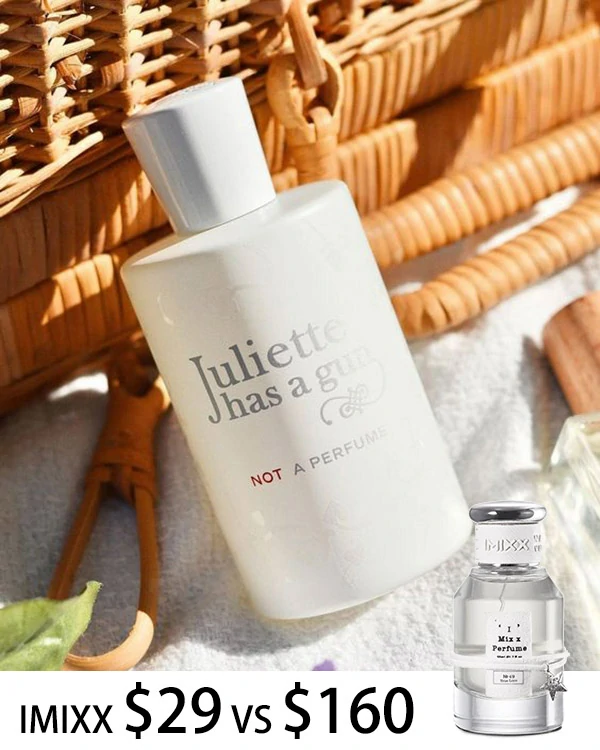
Top 6 FAQs About not a perfume juliette has a gun
When I evaluate not a perfume juliette has a gun, I think the most useful starting point is not whether the fragrance is “good” or “bad.” I want to understand what it is trying to do, what its Cetalox-centered construction actually means, why some people smell it strongly while others barely notice it, and which claims are supported by reliable sources rather than fragrance marketing.
Commercial disclosure
This article is published by imixx perfume, which sells an inspired fragrance in this scent category. That creates a commercial interest, so I want to disclose it before making any comparison. I do not treat our product as automatically equivalent to the original, and I do not use an exact percentage-similarity claim in this guide because I do not have a publicly documented analytical method, blind sensory panel, or other evidence that would justify presenting a precise percentage as an independent fact.
If you are comparing the original with a lower-cost inspired option, you can view our not a perfume juliette has a gun inspired fragrance here. That is a commercial link to our own product. Throughout the rest of this article, I separate that commercial relationship from the factual discussion of the original fragrance, its principal scent material, safety considerations, and practical evaluation methods.
I have also changed the way I handle “experience” in this guide. I will not invent a six-hour, eight-hour, or all-day personal wear result when no controlled wear-test log was supplied with the original article. Instead, I explain exactly how I would test performance, what variables I would control, what conclusions can reasonably be drawn from the available evidence, and what remains subjective. I consider that more useful than creating false precision simply to make a review sound authoritative.
Article Overview: The Six Questions I Think Matter Most
| FAQ | Question I Answer | What I Look At | Why It Helps |
|---|---|---|---|
| 1 | What exactly is this fragrance? | Cetalox, the “single-note” concept, and the difference between a note pyramid and a full ingredient list. | Prevents the common misconception that the entire bottle literally contains only one substance. |
| 2 | What does it smell like? | Woody, ambery, musky, mineral, clean-skin, and perception differences. | Helps set realistic expectations before sampling. |
| 3 | How long does it last? | Substantivity, projection, olfactory adaptation, and a repeatable testing protocol. | Separates “I stopped noticing it” from “the fragrance is no longer detectable.” |
| 4 | Is it unisex, and what about sensitive skin? | Gender-neutral scent design, cosmetic sensitivity, ingredient labels, and responsible safety language. | Avoids treating “minimalist” or “hypoallergenic” as guarantees. |
| 5 | How should I wear and layer it? | Application, dose, placement, climate, clothing, and layering logic. | Makes the advice specific to a persistent amber-woody material rather than generic perfume tips. |
| 6 | Is it worth buying? | Originality, scent style, performance expectations, budget, and evidence behind alternatives. | Lets me make a recommendation without pretending every shopper has the same priorities. |
FAQ 1: What Is not a perfume juliette has a gun, Really?
I describe it as a minimalist woody-amber skin scent built around Cetalox. The official Juliette Has a Gun page places Cetalox in the top, heart, and base positions of its scent pyramid and describes the finished smell as woody, musky, and ambery. The brand also positions the fragrance as a “skin scent” rather than a conventional perfume that moves through clearly separated citrus, floral, spice, and base-note phases.
You can verify that positioning on the official Juliette Has a Gun product page. I use the brand page for information about how the manufacturer describes its own product, but I do not treat every marketing statement on a product page as independent evidence.
The “One Note” Idea Needs a Little More Precision
This is one area where I think many fragrance articles oversimplify the story. When a brand says a perfume is constructed around one note, that does not necessarily mean the entire liquid in the bottle is literally one pure chemical compound.
The official scent pyramid lists Cetalox from top through base, but the same product page lists the finished product ingredients as alcohol denat., parfum, and water. In other words, “one note” is best understood as the olfactory concept: one dominant fragrance identity is intentionally presented across the wear rather than a conventional pyramid of many named notes.
That distinction may sound technical, but I think it matters. It prevents me from repeating a catchy marketing phrase in a way that becomes chemically misleading. A perfume bottle still has a carrier system and a finished cosmetic formula even when the creative scent idea is deliberately minimalist.
Knowledge Point: Note pyramid vs. ingredient declaration
A fragrance “note” is a way of describing what the perfume is designed to smell like. An ingredient declaration serves a different purpose. I therefore do not assume that a note pyramid is a complete chemical formula. In this case, the repeated Cetalox note communicates the perfume’s creative structure, while the finished cosmetic still contains its carrier and fragrance mixture.
What Is Cetalox From a Technical Perspective?
Cetalox is not just a vague marketing term for “amber.” The fragrance-material supplier dsm-firmenich identifies CETALOX as a synthetic molecule in the ambery olfactive family and describes its odor profile as ambery with a strong woody character. Its technical information also positions the material as a heart/base material with high substantivity.
I find that supplier information more useful than simply saying, “It smells like ambergris.” Ambergris-inspired materials are a broad family of modern perfumery effects. What matters to the wearer is that Cetalox combines a dry, diffusive woody-amber profile with persistence, making it capable of forming a substantial part of a fragrance’s drydown rather than functioning like a fleeting citrus top note.
For readers who want the raw-material perspective, the dsm-firmenich CETALOX technical page provides the supplier’s current olfactive and technical description.
Why the Technical Detail Changes How I Evaluate the Perfume
Once I know that the central material is designed to have substantive woody-amber character, I stop expecting the fragrance to behave like bergamot, lemon, or another highly volatile opening material. I also understand why the drydown can feel unusually continuous: the composition is built around maintaining a recognizable olfactory identity rather than showing off several distinct stages.
This does not mean the scent literally smells identical every minute. The concentration reaching my nose changes, my surroundings change, and my sensory attention changes. However, I would describe the development as a change in intensity, texture, and proximity more than a dramatic change in named notes.
FAQ 2: What Does not a perfume juliette has a gun Smell Like?
If I had to reduce the scent profile to a few words, I would call it clean, dry, woody, softly ambery, musky, and skin-like. I would not call it a conventional “fresh” perfume in the sense of lemon, marine notes, or aromatic herbs, and I would not call it a traditional sweet amber dominated by vanilla or resin.
The “clean” effect is more abstract. Depending on the wearer and the person smelling it, I can understand associations with warm skin, clean fabric, dry wood, mineral air, pale amber, or a freshly washed but unscented sweater. Those are impressions rather than literal listed notes.
Why Can Two People Describe It So Differently?
This is where human perception becomes as important as the perfume formula. Odor perception is not a simple machine in which one molecule always creates one identical verbal description for every person. People differ in receptor sensitivity, prior scent associations, attention, context, and familiarity with fragrance materials.
A person who regularly smells modern amber-woody materials may immediately recognize the dry, diffusive structure. Someone encountering the style for the first time may simply call it “clean,” “musky,” “paper-like,” “woody,” or even “almost nothing.” Those descriptions can sound contradictory while still reflecting genuine perception.
I therefore do not treat a review that says “I barely smell it” as proof that the bottle is weak, just as I do not treat a review saying “it lasted all day” as proof that every buyer will get the same experience.
Does It Smell Sweet?
I would place it low on the dessert-like sweetness scale. It does not present itself like caramel, marshmallow, praline, vanilla frosting, syrupy fruit, or honey. Any perceived sweetness is integrated into the warm amber-wood effect.
That matters because “amber” can mean very different things in fragrance writing. Some amber fragrances are dense combinations of vanilla, resins, balsams, and spices. The amber effect here is cleaner and more molecular. If I went into the fragrance expecting a rich vanilla-amber perfume, I would probably misunderstand what the scent is designed to be.
Does It Smell Like “Nothing”?
For some people, apparently yes—or close to it. I would not dismiss that response. A minimalist scent dominated by a particular molecular material is more vulnerable to perceptual differences than a composition containing many strongly contrasting odorants.
If I have low sensitivity to the central odor profile, there are fewer citrus, floral, fruit, spice, or gourmand elements available to compensate. That makes skin testing particularly important here.
Knowledge Point: “I cannot smell it” is a data point, not a universal verdict
When I evaluate a molecular skin scent, I treat low perception as individual evidence. I would test it on skin, step away from the scent for a while, and ask another person to assess it before concluding that the fragrance objectively disappears. That distinction is especially important with a composition that does not keep introducing dramatically different notes.
FAQ 3: How Long Does not a perfume juliette has a gun Last?
I think this question needs to be divided into three separate measurements: longevity, projection, and the wearer’s own awareness. People often combine all three into one statement such as “it was gone in two hours,” but those are not necessarily the same phenomenon.
Longevity asks whether the material remains detectable. Projection asks how far the scent radiates from the body. Wearer awareness asks whether I personally continue noticing it. A fragrance can score differently on each dimension.
Why Cetalox Can Persist Without Feeling Loud
The material supplier describes CETALOX as substantive and suitable for the heart/base area of fine fragrance. That technical profile helps explain why a Cetalox-centered perfume can remain present while becoming less obvious at distance.
Persistence should not automatically be confused with room-filling projection. A material can cling to skin or fabric and still create a relatively intimate scent radius. That is one reason I think “strong” and “long-lasting” should not be used as interchangeable words.
Why I Do Not Give You a Fake Eight-Hour Wear Result
The earlier version of this article discussed performance but did not provide a controlled wear-test log. I could easily make the copy sound more experienced by writing that I sprayed it at 8:00 a.m., smelled it at lunch, and still detected it at 5:00 p.m. But without a documented test, that would be invented evidence.
I would rather be precise about what I know. The brand describes the perfume as moderate in sillage and long-lasting. The raw-material supplier describes Cetalox as highly substantive. Those facts support an expectation of persistence, but neither source guarantees how long a particular bottle will be noticeable on my skin, in my climate, with my spray amount.
The Wear-Test Protocol I Recommend
If I wanted a defensible personal answer, I would use a consistent protocol. I would apply the same number of sprays to clean, unscented skin; note the room or outdoor temperature; avoid another fragranced body product; and record the scent at fixed intervals rather than sniffing continuously.
I would check the opening, approximately one hour later, during the middle of the wear, and again near the end of my normal day. I would record two observations separately: how strongly I can smell it directly on skin and whether another person can detect it at conversational distance.
Most importantly, I would repeat the process on more than one day. One wear is vulnerable to temperature, humidity, activity, clothing, congestion, competing environmental odors, and simple attention effects.
| What I Record | Why I Record It | What It Prevents |
|---|---|---|
| Spray count and location | Keeps dose more consistent between tests. | Comparing two wears that used very different amounts. |
| Temperature and setting | Heat and airflow can affect diffusion. | Treating an outdoor summer wear like an air-conditioned indoor wear. |
| Skin detection | Measures whether scent remains at the application area. | Calling low projection “zero longevity.” |
| Conversational-distance detection | Provides a practical projection check. | Assuming my own scent adaptation represents what everyone else smells. |
| Repeat wear | Shows whether the result is reproducible. | Building a firm conclusion around one unusual day. |
What Is Olfactory Adaptation?
When I remain exposed to a relatively constant odor, my attention to that odor can decline. In everyday language, people often call this becoming “nose blind.” That does not mean the fragrance molecules instantly vanished; it means my sensory system is no longer highlighting the stimulus as strongly.
I think this effect is particularly relevant to a linear skin scent. In a complex perfume, a new stage may introduce a noticeable floral, spice, fruit, or wood effect that attracts my attention again. A more continuous profile gives my brain fewer obvious changes to flag as new information.
FAQ 4: Is not a perfume juliette has a gun Unisex, and Is It Suitable for Sensitive Skin?
From an olfactory perspective, I consider it strongly gender-neutral. I do not see a technical reason that a dry woody-amber and musky skin scent needs to belong to a masculine or feminine category. The official brand likewise markets the fragrance as wearable by any gender.
For me, the more important question is whether I like the material profile. Someone who enjoys dry amber woods and clean musks may enjoy it regardless of gender identity. Someone who wants a very floral, sugary, fruity, or traditionally aromatic fragrance may not.
Minimalist Does Not Mean Allergy-Proof
This is where I want to separate scent simplicity from medical safety. A perfume can have a minimalist creative concept and still be a cosmetic product that is unsuitable for a particular individual.
The U.S. Food and Drug Administration notes that some fragrance components can cause allergic reactions or sensitivities in susceptible people. The FDA also states that terms such as “hypoallergenic” do not have a federal standard or definition governing their use in cosmetics in the United States.
For that reason, I do not tell a reader that a fragrance is guaranteed safe for sensitive skin simply because the scent pyramid looks simple. The more responsible approach is to review the current ingredient declaration on the actual product, avoid ingredients associated with a known personal allergy, and consult an appropriate medical professional when there is a history of significant reactions.
The FDA’s current consumer information is available on its Allergens in Cosmetics guidance page.
Knowledge Point: I separate fragrance preference from health claims
I can reasonably discuss whether a scent feels clean, dry, woody, musky, strong, or subtle. I cannot responsibly promise that an individual with allergies, asthma, migraines, dermatitis, or fragrance sensitivity will tolerate it. Those are different questions and require different evidence.
What If I Am Sensitive to Strong Fragrance but Not Allergic?
Intensity preferences are also personal. A fragrance that stays close to the body may be easier for some people to manage than a high-projection sweet perfume, but “less projecting” does not mean universally comfortable.
If I know that fragrance can trigger headaches or discomfort for me, I would sample cautiously, use a minimal amount, and avoid interpreting another person’s positive experience as evidence that I will respond the same way.
FAQ 5: How Do I Wear and Layer Juliette Has a Gun Not a Perfume?
This is where I think the Cetalox-centered construction becomes practically interesting. Because the profile is relatively uncluttered, I can think about it in two different ways: as a complete minimalist fragrance by itself or as a woody-amber support layer beneath another scent.
How Much Would I Apply?
I would begin conservatively rather than trying to force projection. The central material is substantive, and repeatedly adding sprays simply because I stop noticing the scent may create a stronger experience for everyone around me while doing little to overcome my own sensory adaptation.
My starting amount would depend on the atomizer, environment, clothing, and distance from other people. There is no universal number of sprays that is scientifically “correct.” A large atomizer can deposit substantially more liquid than a small one, which is another reason spray counts are only rough comparisons.
Where Would I Apply It?
I would choose a few areas rather than saturating every pulse point. Neck application gives the fragrance warmth and movement. Upper chest application can produce a more contained aura under clothing. Inner elbows can be useful when I want to assess the scent without placing it constantly under my nose.
The official brand advises spraying on pulse points and allowing the perfume to air-dry rather than rubbing it. I consider that straightforward application guidance, not a requirement that dramatically changes the chemistry of the fragrance.
Would Moisturized Skin Help?
The brand recommends applying fragrance over unscented body lotion for longevity. I think the “unscented” part is particularly important for evaluation. If I am trying to understand the perfume itself, a strongly fragranced moisturizer adds another composition and makes the test less controlled.
I would therefore use either clean bare skin or a genuinely low-odor moisturizer when I am testing performance. Once I already understand the fragrance, I can experiment more freely.
How I Would Layer It Without Creating Noise
I would use the fragrance as a supporting texture rather than automatically applying equal quantities of two perfumes. The woody-amber material can potentially add warmth, dryness, persistence, or a clean-skin effect to another composition.
With a bright citrus scent, I would expect the combination to feel less top-heavy as the citrus evaporates. With a floral perfume, I would expect more emphasis on the smooth woody-musky base. With vanilla, I would look for a drier, less dessert-like finish. With another woody perfume, I would be careful because two powerful woody-amber structures can become more forceful than expected.
My Layering Rule
I test each fragrance alone before combining them. Then I change only one variable at a time. If I immediately apply large amounts of both scents, I learn almost nothing about which material is improving—or hurting—the result.
FAQ 6: Is not a perfume juliette has a gun Worth Buying?
I think it can be worth buying for the right person, but I would not call it a universal recommendation. Its strength is also its limitation: the concept is deliberately narrow.
If I enjoy clean woody-amber materials, skin scents, low visual “noise” in a fragrance composition, and flexible layering, the design makes sense. If I equate value with a long list of recognizable notes, dramatic evolution, heavy sweetness, or room-filling projection, I may feel that the perfume offers too little.
Who I Think Is Most Likely to Appreciate It
I see the strongest fit for someone who wants a fragrance that feels integrated with the wearer rather than obviously decorative. It can make sense for offices, close social settings, travel, minimalist wardrobes, and situations where I do not want my perfume to enter a room before I do.
It also makes sense for a fragrance enthusiast who enjoys examining individual materials. Because the structure is stripped down, I can pay more attention to the character of a modern amber-woody material than I could inside a dense composition with many competing notes.
Who I Think Should Sample Before Committing
I would strongly recommend sampling first if I have difficulty perceiving molecular amber or musk-style fragrances, if I want high projection, or if I am buying mainly because of online hype.
This is not the type of fragrance where I think a reviewer’s performance number should substitute for my own test. Perceptual variation is simply too important.
My Product Comparison: What I Can and Cannot Claim
One of the biggest trust problems in the previous version was presenting a retailer’s own inspired product beside the original as though all options had been independently established as equivalent. I do not think that is a strong comparison method.
Because imixx perfume has a commercial interest in its own product, I label that relationship clearly below. I also distinguish between facts that can be checked from a manufacturer’s own product information and similarity judgments that would require comparative testing.
Juliette Has a Gun Not a Perfume
Relationship to this article: Third-party original fragrance.
What I can verify: The brand identifies Cetalox as the central top, heart, and base note and describes the profile as woody, musky, and ambery.
What I would test personally: My sensitivity to the material, projection, longevity, and whether its minimalist profile justifies the price for me.
Evidence status: Product identity and brand claims can be checked against the official manufacturer’s information.
Not a Perfume Superdose
Relationship to this article: Another product from the original brand.
What I can responsibly say: It is positioned as a more intense variation within the brand’s Not a Perfume concept.
What I would test personally: Whether stronger presence improves the experience or makes the amber-woody material too dominant for my taste.
Evidence status: I would rely on the manufacturer’s current specifications and direct sampling rather than assuming “Superdose” automatically means better performance for everyone.
imixx perfume Inspired Option
Relationship to this article: Commercially related product sold by this site’s publisher.
What I can responsibly say: It is offered for shoppers seeking a lower-cost interpretation of this scent direction.
What I will not claim without evidence: I will not present it as chemically identical, objectively equal to the original, or assign a precise similarity percentage without a disclosed methodology that supports that number.
Evidence status: Shoppers should judge scent resemblance and performance through direct comparison, transparent testing information, and their own wearing experience.
A More Trustworthy Way to Compare the Options
| Comparison Question | Original | Superdose | imixx perfume Inspired Option |
|---|---|---|---|
| Is the brand identity verifiable? | Yes, as the original product. | Yes, as an original-brand variation. | Yes, as an inspired product sold by this publisher. |
| Can I assume identical formula? | Not applicable. | No; it is a different version. | No. I would not make that assumption. |
| Can I assume identical performance? | Performance still varies by wearer. | No. More intense positioning does not guarantee the same experience for everyone. | No. Direct comparative wear testing is needed. |
| What is the best buying method? | Sample and evaluate the original on skin. | Compare directly with the standard version. | Compare scent, drydown, performance, price, and return policy rather than relying on a retailer’s similarity claim alone. |
Why I Do Not Use a Precise Similarity Percentage as Proof
A number such as 95%, 98%, or 99% looks scientific, but a percentage is only meaningful when I know what was measured and how. Was it based on GC-MS analysis? A trained sensory panel? Consumer preference testing? Formula overlap? Headspace analysis? A blind triangle test? An internal perfumer’s opinion?
Those methods answer different questions. Two formulas could contain many of the same materials but smell noticeably different because concentrations differ. Conversely, two formulas could use different materials to create a similar overall olfactory effect.
For that reason, I do not consider a naked percentage sufficiently informative. If a retailer makes an exact similarity claim, the strongest version of that claim would disclose the method, sample size, test conditions, evaluation criteria, and whether the testing was independent.
Until that evidence is available, I think the more defensible wording is simply that a product is intended to interpret a similar scent direction. The shopper can then judge the result rather than being asked to accept a precision number that has no visible measurement framework.
Why Reviews of This Fragrance Can Be So Contradictory
I often see three types of comments around minimalist molecular fragrances: “It lasts forever,” “It disappeared immediately,” and “Other people can smell it but I cannot.” Instead of assuming one group is wrong, I think all three reports can contain useful information.
The central material has substantive characteristics, but individual odor sensitivity and sensory adaptation can differ. Application quantity can differ. Climate can differ. One reviewer may spray clothing, another may spray dry skin, and another may test a single spray from a sample vial. Those are not equivalent tests.
Climate Changes the Experience
In warmer conditions, fragrance materials generally diffuse into the surrounding air more readily. That can make a perfume feel more expansive while also changing how quickly certain parts of the formula leave the skin.
In cold conditions, the same scent can feel more restrained. Clothing can also trap fragrance and release it gradually with movement. If I compare a summer outdoor test with a winter indoor test without noting the context, I may incorrectly conclude that the product itself changed.
Application Method Changes the Experience
A direct spray from a full-size atomizer may deposit a different amount from a small sample sprayer. Moisturized skin may behave differently from very dry skin. Clothing may retain scent differently from bare skin.
This is why I prefer repeatable testing over a single anecdote. A useful review should explain the conditions of the test, not just announce a number of hours.
My Practical Evaluation Framework Before I Buy
I use four questions before I decide whether a minimalist fragrance is worth full-bottle money.
Knowledge Point: My four-part buying framework
First: Can I perceive the central scent clearly on my own skin? Second: Do I still enjoy it after the opening novelty is gone? Third: Does its projection fit the situations in which I actually wear perfume? Fourth: Does the price make sense relative to how frequently I expect to reach for it? I find these questions more useful than asking whether the fragrance is universally “worth it.”
I Test the Scent Before I Test the Story
Brand history, bottle design, social-media popularity, and reviews can all influence expectations. I therefore try to understand the fragrance itself before deciding whether the surrounding story adds value.
With a minimalist composition, this matters even more. There are fewer obvious notes to distract from the central question: do I actually enjoy the material profile?
I Test Normal Wear, Not Only Store-Counter Impact
A fragrance does not need to create a dramatic first five minutes to be useful. I want to know how it behaves during the hours in which I am working, studying, commuting, eating, or talking with other people.
A subtle fragrance that fits those environments may give me more practical wear than a powerful perfume I only feel comfortable using occasionally.
When I Think This Scent Style Works Best
Office and Close-Contact Settings
I think a controlled woody-musky skin scent can work well when I spend significant time near other people. That does not mean every workplace welcomes fragrance, and fragrance-free policies should always be respected. But when fragrance is appropriate, moderate projection can be an advantage rather than a weakness.
Travel
A neutral woody-amber profile is easy to combine with different clothing styles and occasions. When I want one fragrance to move from daytime activities to dinner without feeling overly formal, sweet, sporty, or seasonal, this type of scent has practical flexibility.
Warm Weather
The absence of dense gourmand sweetness can make the style feel less heavy in heat. I would still control my spray amount because warm conditions can increase diffusion.
Minimalist Fragrance Wardrobes
If I prefer owning a small number of versatile products, a skin scent can fill several roles: casual wear, work, layering, travel, and low-key evening use. That versatility may matter more to me than having twenty clearly distinguishable notes.
What I Look for When Buying the Original or an Inspired Version
I separate authenticity from similarity. If I want the original brand product, I buy from the brand or a retailer whose supply chain I trust. If I intentionally want an inspired fragrance, the relevant questions are different: Is the seller transparent about what it is? Are the product specifications clear? Is the return policy understandable? Is performance described realistically? Are similarity claims supported rather than merely repeated?
I also compare total value rather than bottle price alone. Bottle size, price per milliliter, shipping, return options, frequency of wear, and whether I actually enjoy the drydown all matter.
A cheaper bottle I never wear is not a bargain. An expensive bottle I use constantly may provide better personal value. Conversely, if I like the scent direction but do not care about original-brand ownership, an inspired option may fit my priorities better—provided I evaluate it on its own merits rather than assuming equivalence.
How I Store a Minimalist Fragrance
I store fragrance away from prolonged direct sunlight and excessive heat. The official brand similarly recommends a cool, dark environment. I would rather use a drawer, cabinet, or closet than leave a bottle in a sunny window or hot vehicle.
I also keep the bottle properly closed when possible. Fragrance contains volatile materials, and stable storage conditions are a simple way to avoid unnecessary environmental stress on a product I may own for years.
I do not obsess over perfect laboratory storage. I simply avoid the most obvious extremes: repeated high heat, strong direct sunlight, and careless storage in places where the bottle experiences major temperature swings.
My Final Assessment
What interests me about not a perfume juliette has a gun is not the number of notes. It is the opposite: the fragrance makes a modern amber-woody material the central experience and removes much of the decorative complexity that normally surrounds it.
That simplicity makes the fragrance easy to describe badly. Calling it merely “clean” misses the woody-amber structure. Calling it literally one ingredient confuses the note concept with the finished cosmetic formula. Giving it a universal eight-hour performance rating ignores differences in perception, environment, and dose. Calling any inspired version “the same” without comparative evidence turns editorial content into marketing copy.
I think the more useful conclusion is conditional. If I enjoy dry amber woods, clean skin scents, subtle projection, and fragrances that can function alone or as a layering base, I would consider it highly relevant. If I want strong fruit, obvious flowers, gourmand sweetness, smoke, spice, or a dramatic top-to-base transformation, I would look elsewhere.
I would also sample before buying whenever possible. This specific fragrance style depends heavily on how clearly I perceive its central material. That makes my own nose more important than another person’s rating.
For shoppers comparing the original with a commercially related inspired option sold by imixx perfume, I would apply the same standard to both: smell them, wear them under comparable conditions, compare their drydowns and projection, and decide whether the price difference matters to me. I would not use brand prestige alone to decide, but I would also not use an unsupported similarity percentage as a substitute for evidence.
That approach is less dramatic than promising a universal winner, but I think it is more useful. My goal is not to tell every reader what to buy. It is to make the differences clear enough that a reader can make a better decision.
Key-Points FAQ
Editorial and Source Transparency
Commercial relationship: This website sells an imixx perfume product inspired by this fragrance category. I disclosed that relationship near the beginning of the article rather than presenting the product comparison as independent editorial coverage.
Evidence standard: I use manufacturer information to establish how a product is officially positioned, raw-material supplier information for technical characteristics of Cetalox, and FDA information for U.S. cosmetic-sensitivity context. I distinguish those sourced facts from subjective scent descriptions.
Experience limitation: I do not claim a specific personal wear-test duration because the source material supplied for this rewrite did not contain a documented controlled wear log. Instead, I provide a repeatable evaluation protocol that can generate meaningful personal performance data.
Similarity claims: I do not rely on a precise percentage of similarity between an inspired fragrance and the original unless the measurement methodology is disclosed well enough to evaluate the claim.
This article is intended for fragrance education and shopping research. Scent perception and performance are subjective, and the safety discussion is general consumer information rather than medical advice.