

How to Choose the Best Byredo Open Sky Dupe in the USA: A Perfumer’s Guide to Scent DNA, Longevity, Ingredients & Value
When I evaluate a Byredo Open Sky Dupe, I do not begin with the price, an advertised similarity percentage, or the first ten seconds after spraying. I begin with the fragrance architecture. Open Sky is distinctive because its bright pomelo and black-pepper opening has to move into an unusual green hemp character before becoming progressively drier and woodier through vetiver and palo santo. A fragrance can reproduce the citrus opening and still miss the composition that makes Open Sky recognizable.
For a US shopper researching a Byredo Open Sky Dupe, I think the most useful approach is to evaluate the fragrance over time rather than asking whether it smells “identical” immediately. In this guide, I use IMIXX No.11 Inspired by Open Sky as the product case study, but I apply the same standards I would use when examining any fragrance built around this scent direction: opening accuracy, transition, heart character, drydown identity, concentration, diffusion, longevity, price transparency and the quality of the evidence supporting technical claims.
My disclosure before I begin
I am writing on the IMIXX website, and IMIXX sells the product discussed in this article. That commercial relationship matters. I do not want a reader to mistake a brand-owned guide for an independent consumer publication.
For that reason, I separate three kinds of information throughout this guide: independently documented facts about the original fragrance, specifications published by IMIXX about its own product, and sensory or formulation judgments that remain interpretive. I do not treat an IMIXX marketing statement as third-party proof merely because it appears on a product page.
This distinction is particularly important in the fragrance category because numerical marketing claims can sound more scientific than they really are. An exact similarity percentage, a precise longevity number or a laboratory reference can be useful only when the method behind it is clear enough to understand and reproduce. If that methodology is not publicly available, I treat the statement as a manufacturer claim rather than independent verification.
My purpose is therefore not to tell you that one bottle is objectively perfect. My purpose is to give you a better way to judge whether an Open Sky alternative actually recreates the features you value in the original scent profile.
What Independent Sources Establish About the Original Open Sky
Before I evaluate an inspired fragrance, I want a reliable reference point for the fragrance being interpreted. That means separating the documented note structure from advertising language.
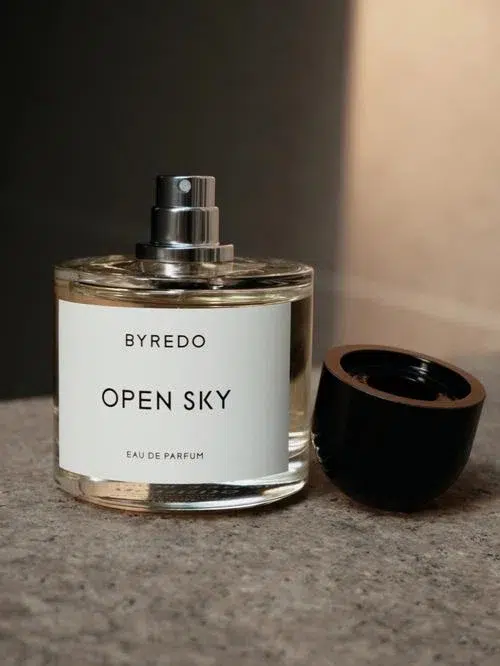
Industry publication Perfumer & Flavorist reported the 2021 launch of Open Sky as a limited-edition Eau de Parfum and documented black pepper and pomelo in the top, hemp leaves in the heart, and vetiver with palo santo in the base.
That independent reference matters to me because it provides a stable olfactory framework that does not originate from IMIXX. I can therefore evaluate an Open Sky-inspired composition against a documented citrus-spice-green-wood structure rather than allowing a seller to define its own benchmark.
| Stage | Documented Open Sky Direction | What I Listen for Olfactorily | A Common Mismatch |
|---|---|---|---|
| Opening | Pomelo + black pepper | Bitter-bright peel, airy citrus, dry sparkling spice | Sugary grapefruit or lemon-cleaner freshness |
| Heart | Hemp leaves | Green, herbal, earthy and terpenic character | Generic amber sweetness replacing the green center |
| Drydown | Vetiver + palo santo | Dry roots, aromatic woods, earth and restrained smoke | Anonymous woody musk with little relation to the opening |
My key principle: I evaluate the movement between these stages, not merely the presence of the right note names. In perfumery, the transition from one accord to another often tells me more than the note pyramid itself.
Why Open Sky Is Harder to Reconstruct Than Its Short Note List Suggests
A consumer-facing note list can make a fragrance appear simple. Pomelo, black pepper, hemp, vetiver and palo santo sounds like a compact formula. It is not a formula, however. It is an abbreviated description of perceived odor effects.
When I think about recreating a pomelo effect, I am not thinking only about a fruit name. I am thinking about brightness, bitterness, rind, juiciness, dryness, diffusion and sweetness. A citrus accord that becomes too sweet may read as grapefruit candy. Push the acidity too far and the opening can become sharp. Remove the bitter peel effect and the composition loses part of the tension that makes the profile distinctive.
Pomelo Is an Effect, Not a Single Formula
In fine fragrance, many familiar “notes” are reconstructed olfactory impressions. A perfumer may work with natural materials, isolates and aroma chemicals to create the sensory idea of a fruit, flower, wood or abstract atmosphere.
For the Open Sky direction, I want the citrus to feel luminous without becoming juicy-sweet. I expect a slight rind-like bitterness because that dryness prepares the nose for the herbal heart and woody base.
If an inspired fragrance delivers a brilliant grapefruit-like blast but turns sweet and shampoo-like after ten minutes, I may enjoy it as a fragrance, but I would regard it as a weaker interpretation of this particular scent architecture.
Black Pepper Has to Create Lift Without Taking Over
Black pepper is equally sensitive to proportion. At an appropriate level, pepper can make citrus feel more electric and three-dimensional. It contributes dryness and movement without necessarily smelling like a kitchen spice jar.
At a different dosage, the same concept can become abrasive, dusty or excessively warm. I therefore do not ask simply, “Can I smell pepper?” I ask whether the pepper improves the pomelo accord and helps bridge the opening into the green heart.
The Hemp Accord Is the Identity Test
The green heart is where I think many interpretations either become recognizably Open Sky-like or lose the plot.
A hemp or cannabis-style fragrance accord can draw on green, herbal, terpenic, earthy and sometimes sulfurous odor impressions. Different wearers can describe the same accord differently because olfactory memory is personal. Someone familiar with fresh cannabis flower may recognize that association immediately. Another wearer may simply describe the effect as crushed leaves, herbs or grassy earth.
For me, the important question is whether the green accord creates tension with the citrus instead of becoming either invisible or overwhelmingly literal.
I do not need the fragrance to smell like cannabis smoke. In fact, if the entire center becomes smoky or heavily skunky, I think it can obscure the freshness that gives the composition its unusual contrast.
Vetiver and Palo Santo Have to Complete the Story
The final stage cannot be treated as a generic long-lasting base.
Vetiver is particularly variable as an olfactory material and accord. Depending on the material, treatment and surrounding formula, it can suggest roots, grass, dry wood, earth, smoke or mineral freshness. Palo santo contributes another dry aromatic-wood dimension.
Together, they should ground the fragrance without making it heavy. I want to sense a relationship between the dry woody finish and the brightness that came before it.
If everything turns into a generic woody-amber or musk after two hours, persistence may still be good, but the fragrance has lost informational continuity.
My Testing Method: How I Evaluate an Open Sky-Inspired Fragrance
I think a credible fragrance review should explain its process. “It smells 95% similar to me” tells a reader almost nothing about how that judgment was reached.
I prefer a structured wear protocol that another person can understand and approximate at home.
My repeatable consumer wear-test protocol
- I compare fragrances using the same number of sprays.
- I use clean skin without another fragrance underneath.
- I use a fragrance blotter alongside skin when I want to distinguish formula development from skin effects.
- I record the opening around 5–15 minutes rather than making a conclusion at the instant of spraying.
- I revisit the heart around 60–90 minutes.
- I return several hours later to assess the drydown and remaining identity.
- I consider projection and longevity separately.
- I note unusually hot, cold, dry or humid conditions.
- I repeat important judgments on more than one wearing before treating them as representative.
I want to be precise about what this is and is not. It is a practical sensory-evaluation framework. It is not a blinded clinical sensory panel, a statistically powered consumer study or independent laboratory certification.
That limitation matters. If I have not performed a controlled third-party study, I should not write as though I have.
Stage One: The First 15 Minutes
During the opening, I pay attention to shape rather than sheer strength. Does the citrus feel bitter-bright and slightly dry? Is there a peel impression? Does black pepper increase sparkle without becoming harsh?
I also watch how quickly the opening transforms. Many bright citrus effects are relatively volatile. Producing an attractive first spray is therefore only the beginning of the test.
If the fragrance wins the first thirty seconds and then loses its identity, I do not consider the reconstruction successful merely because the initial side-by-side comparison was convincing.
Stage Two: Approximately 30 Minutes to 3 Hours
This is usually the most informative section of the wear.
As the brightest citrus effects decrease, I expect the green character to become easier to perceive. I look for herbal dryness, earthiness and a subtle terpenic quality. I do not want the transition to feel like somebody suddenly replaced one perfume with another.
I also pay attention to what remains from the opening. Good composition often allows different stages to overlap. Traces of citrus can remain around the emerging green accord, creating continuity.
If pomelo disappears and a generic sweet amber arrives abruptly, the fragrance may still smell pleasant, but it no longer communicates the same olfactory narrative.
Stage Three: Several Hours Later
During the drydown, I stop asking how loud the fragrance is and ask whether I can still identify its character.
Vetiver should contribute dry, rooty or earthy support. Palo santo should reinforce the aromatic wood direction. A restrained smoky impression can make sense; an anonymous blanket of musk tells me far less.
This is why I distinguish longevity from meaningful longevity. A fragrance can remain technically detectable long after the recognizable composition has disappeared.
My Fragrance Evaluation Scorecard
| Criterion | When I Assess It | Positive Signal | Reason for Caution |
|---|---|---|---|
| Pomelo texture | 0–15 min | Bright, dry, rind-like and faintly bitter | Candy-like sweetness or generic lemon freshness |
| Pepper balance | 0–30 min | Sparkle, lift and dryness | Abrasive spice dominating the citrus |
| Green heart | 30 min–3 hr | Herbal, earthy, distinctive and integrated | Absent, syrupy or exaggerated into caricature |
| Drydown identity | 2+ hr | Dry vetiver and aromatic woody character | Generic musk unrelated to the opening |
| Projection | First several hours | Readable scent bubble appropriate to setting | Either disappears immediately or overwhelms the environment |
| Longevity | Full wearing | Recognizable scent character remains | Only an anonymous base survives |
| Evidence quality | Before accepting claims | Method, conditions and source are stated | Precise statistics without accessible methodology |
Why the Same Note Pyramid Can Produce a Very Different Smell
I do not use note lists as ingredient recipes because they are not equivalent.
Raw-Material Choice Changes the Odor Profile
Take vetiver as an example. Different materials and constructions can emphasize earth, root, smoke, wood, grass or mineral facets. A formula can therefore list “vetiver” and still smell substantially different from another perfume whose marketing page uses the same word.
Citrus is similar. A perfumer can build a pomelo-like impression with multiple materials. What I ultimately perceive is determined by the complete accord, dosage and surrounding ingredients.
Dosage Can Change the Meaning of an Accord
A small amount of a sharp material may provide brilliance. Increase it and the same material can become the dominant character.
This is especially relevant to peppery, green, sulfurous and powerful woody materials. Successful reconstruction therefore depends on proportion rather than simply identifying as many molecules or note names as possible.
Volatility Creates a Time-Based Composition
Perfume changes because different materials evaporate and diffuse at different rates. What I smell five minutes after spraying is not simply a stronger version of what remains four hours later.
That is why I look for a coherent evaporation curve in an Open Sky inspired perfume. I want the brighter citrus-pepper effect to introduce the green heart and for that heart to make sense when the vetiver-palo santo base becomes dominant.
Knowledge point: I use “top,” “heart” and “base” as sensory-navigation tools rather than rigid chemical compartments. Some base materials are detectable immediately, while supporting materials can extend a top-note impression well beyond the opening.
Why I Do Not Use a GC-MS Result as a Shortcut to Sensory Similarity
Instrumental analysis can be valuable in fragrance development. I think the problem begins when legitimate analytical techniques are simplified into consumer marketing language that implies more certainty than the measurement provides.
Gas chromatography can separate volatile components in a complex mixture. Coupled with mass spectrometry, it can help analysts investigate chemical composition and identify components under appropriate analytical conditions.
For a fragrance manufacturer, this information can be useful when combined with raw-material expertise, supplier documentation, reference standards, formulation trials and sensory evaluation.
But chemical analysis and human sensory perception are not the same measurement.
Odor perception depends on thresholds, ratios, mixture effects, masking, enhancement, volatility and the way the human olfactory system processes combinations. A component present at a small analytical concentration can have a major sensory effect if its odor threshold is extremely low.
Skin and environmental conditions add another layer of variability.
My evidence standard for an exact similarity percentage
I would want to know what was measured, what reference sample was used, how samples were prepared, how the percentage was calculated, whether trained sensory assessment was included, how many evaluators participated, whether testing was blinded, and whether another qualified party could reproduce the result. Without that information, I treat the percentage as a manufacturer-originated claim rather than independent proof of how consumers will perceive the fragrance.
That is why I use more restrained language for IMIXX No.11 in this guide: I describe it as a fragrance designed around the recognizable Open Sky scent profile. That statement can be assessed through the actual note direction and through wear testing without pretending that sensory perception can be reduced to a single unexplained number.
Maceration and Maturation: What I Think Consumers Actually Need to Know
“Maceration” has become common vocabulary in online fragrance discussions, but people often use the word for several different ideas.
In manufacturing, a finished fragrance mixture may be rested or matured under controlled conditions as part of the production process. Depending on the formula and workflow, the production team may examine odor consistency, appearance, stability and readiness for later processing such as filtration and filling.
I do not think consumers should interpret this as evidence that every bottle becomes dramatically stronger after sitting in a bedroom drawer for three months.
If the formula has structural problems, waiting is not a substitute for reformulation.
From a manufacturing perspective, I find batch repeatability more interesting than a large advertised number of maturation days. If I were auditing fragrance production, I would ask whether the citrus profile remains consistent across batches, whether the green accord shifts, whether coloration or clarity changes unexpectedly and whether the finished fragrance behaves consistently under intended storage conditions.
Longevity, Projection and Sillage Are Different Performance Metrics
When I see shoppers searching for a long-lasting Byredo Open Sky Dupe, I think one distinction can prevent a lot of disappointment: longevity is not projection.
Longevity describes how long I can detect the fragrance.
Projection describes how far the fragrance radiates around me at a particular stage.
Sillage describes the scented trail that remains around a moving wearer.
A perfume can be detectable for eight hours while becoming a close skin scent after two. Another can fill a room initially and disappear much earlier.
I therefore do not find the word “strong” very informative unless I know which performance dimension the reviewer means.
Why I Avoid Universal Longevity Guarantees
Performance is affected by the complete formula, amount applied, application surface, skin condition, temperature, humidity, clothing and individual perception.
If I publish a specific performance result, I think it should be accompanied by context: number of sprays, skin or blotter, approximate environmental conditions, assessment intervals and number of wearings.
Without that information, a statement such as “lasts 12 hours” sounds precise but leaves important variables unstated.
This is one of the areas where I deliberately separate IMIXX promotional material from independently established evidence. If a specific performance figure comes from the brand, I regard it as a brand claim unless the corresponding test method is available.
How Skin and USA Climate Can Change Your Experience
A single performance number is especially difficult to generalize across the USA because the country contains very different climates.
A fragrance can behave differently in humid South Florida, dry Southern California, a cold northeastern winter or a high-altitude environment. Warmer conditions generally increase volatility and can make bright aromatic materials feel more expansive at first. Cooler conditions can slow diffusion.
Dry skin can also affect perceived persistence. Fabric may retain some fragrance materials longer than skin, although spraying clothing requires common sense because some perfume materials can stain delicate fabrics.
My Practical USA Wear-Test Routine
- I apply fragrance to clean skin.
- I use lightly moisturized skin when dryness is an issue.
- I avoid strongly scented body products during a serious comparison.
- I use the same spray count when comparing fragrances.
- I evaluate both skin and blotter when I want more context.
- I note unusual heat, cold or humidity.
- I repeat the test in the season when I intend to wear the fragrance.
- I do not judge an entire bottle from one unusual wearing.
Practical point: If your experience differs from another reviewer’s longevity report, that does not automatically mean either person is dishonest. Different application conditions, environments and sensory thresholds can produce genuinely different results.
Does the Cannabis Note Actually Smell Like Marijuana?
This is one of the most important blind-buy questions surrounding an Open Sky-inspired fragrance.
My answer is nuanced: a green hemp/cannabis accord can remind some people strongly of fresh cannabis plant material, but I would not automatically translate that into “it smells like weed smoke.”
A perfumer can create cannabis-like associations through green, herbal, terpenic, earthy and sulfurous facets. Different consumers interpret those facets through their own odor memories.
Someone familiar with fresh cannabis flower may identify the association immediately. Another person may interpret the same combination as crushed leaves, grapefruit rind, herbs and earthy vetiver.
For me, the ideal balance in this scent direction is recognizably unusual without allowing the cannabis association to consume everything around it.
My blind-buy caution: If you strongly dislike fresh herbal cannabis associations, bitter citrus, black pepper or dry vetiver, I would sample this scent direction first whenever sampling is practical. Price alone is not a reason to buy a scent profile you may dislike.
When Does an Open Sky-Inspired Perfume Work Best?
I think this architecture naturally favors spring and summer because citrus, pepper and green aromatic effects become vivid in warmer weather.
The base gives it more range than a conventional fresh citrus fragrance, however. Vetiver and palo santo add enough dryness and wood to make the profile interesting in early fall and in milder USA climates.
For everyday use, I would consider it appropriate for daytime, travel, outdoor situations, casual offices and warm evenings.
If you primarily enjoy dense vanilla, gourmand amber, syrupy fruit or heavy oud, this profile may feel austere. If you like dry citrus, green woods, pepper, vetiver and aromatic fragrances with unusual transitions, it is much more likely to fit your taste.
My IMIXX No.11 Case Study: Facts, Brand Claims and Unknowns
This is where I think trust requires especially careful language.
The current IMIXX product page publishes basic product information about No.11 Inspired by Open Sky. Those details can be cited as IMIXX-published specifications. They should not be confused with independent verification.
IMIXX No.11 Inspired by Open Sky
Current listed price: $39 USD
Listed bottle size: 50 ml / 1.7 oz
Availability: Listed in stock when this article was reviewed
Review count shown: 13 verified reviews when checked
Positioning: Inspired by the Open Sky scent direction
Evidence type: Brand-published product-page information.
Original Open Sky Reference
Release context: 2021 limited edition
Reported original format: Eau de Parfum
Reported launch size: 100 ml
Historical launch price: $270 USD
Documented direction: Pomelo + pepper → hemp → vetiver + palo santo
Evidence type: Independent fragrance-industry reporting.
What I Can State Confidently
I can state that IMIXX currently markets No.11 specifically as an Open Sky-inspired product. I can state the current displayed price and bottle size at the time of this article update. I can also compare that information with the independently documented note architecture and historical launch context of Open Sky.
What I Would Not Present as Independent Proof
I would not convert a brand’s similarity percentage into an independent scientific conclusion without access to its full methodology and underlying evidence.
I would not guarantee a universal number of wear hours without standardized conditions.
I would not say that a lower-priced fragrance contains materials of identical grade, provenance or dosage to a luxury reference unless supplier documentation or other appropriate evidence establishes that fact.
And I would not claim that every consumer will perceive the two fragrances identically.
Why this distinction improves the recommendation
I think a recommendation becomes more trustworthy when I explain its limits. Saying “this product is designed to recreate the recognizable Open Sky architecture, and here is how I suggest evaluating it” gives the buyer something testable. Saying “this must smell exactly the same to everyone” does not.
Why a Factory-Direct Fragrance Can Cost Less Without Proving Equal Quality
This is an area where manufacturing and supply-chain context can provide more value than conventional “cheap dupe” language.
The retail price of a luxury perfume pays for more than fragrance concentrate. Depending on the business model, the final price can reflect bottle tooling, decoration, caps, pumps, cartons, freight, storage, inventory, wholesale relationships, retailer margin, sampling programs, media production, physical retail, marketing and brand equity.
A digitally focused or factory-direct fragrance business can operate with a different cost structure.
That does not prove that every low-priced fragrance uses the same materials as every luxury fragrance. It simply means that retail price is not a direct measurement of the quantity or quality of aromatic material inside the bottle.
I therefore think the more intelligent consumer question is not, “How can a $39 fragrance possibly be good?”
The better questions are:
- How much product am I receiving?
- What scent direction is the formula designed to reproduce?
- Are the basic specifications transparent?
- Does it smell coherent from opening to drydown?
- Does its performance meet my needs?
- Are technical claims appropriately supported?
- Which parts of the retail price relate to the liquid and which relate to the business model around it?
Price per Milliliter: How I Normalize the Value Comparison
Bottle price alone can be misleading because bottle sizes differ.
At a listed $39 for 50 ml, IMIXX No.11 is approximately $0.78 per ml.
The historical 2021 Open Sky launch reference of $270 for 100 ml works out to approximately $2.70 per ml.
This mathematical comparison is useful because it normalizes size. It does not prove equal formula quality, identical ingredients or equivalent performance.
| Factor | Original Open Sky Historical Reference | IMIXX No.11 Current Listing |
|---|---|---|
| Scent direction | Pomelo, black pepper, hemp, vetiver, palo santo | Designed around the Open Sky profile |
| Size used here | 100 ml | 50 ml |
| Reference price | $270 historical 2021 launch price | $39 current listed price |
| Approx. price/ml | $2.70/ml | $0.78/ml |
| What this establishes | A measurable difference in price positioning. It does not establish chemical or sensory equivalence. | |
USA Fragrance Safety: What I Verify Instead of Using Vague Claims
I think fragrance brands should be careful with regulatory language because terms such as “approved,” “certified” and “100% safe” can imply specific legal or scientific meanings.
The U.S. Food and Drug Administration explains that perfume and cologne intended to be applied to the body for cosmetic purposes are examples of fragrance products regulated as cosmetics. FDA also states that fragrance ingredients in cosmetics must meet applicable safety requirements and that companies manufacturing or marketing cosmetics have responsibility for ensuring products are safe and properly labeled.
FDA further explains that cosmetic fragrance ingredients do not generally undergo premarket FDA approval in the way consumers may associate with approved pharmaceutical drugs.
That is why I avoid describing an ordinary perfume casually as an “FDA-approved fragrance.”
What IFRA Standards Actually Mean
The International Fragrance Association explains that the IFRA Standards can prohibit a fragrance material, restrict the maximum quantity or conditions of use, or establish specifications such as purity criteria.
IFRA also makes another distinction I think consumers should understand: IFRA itself does not issue a fragrance mixture’s Certificate of Conformity. The fragrance mixture supplier establishes the certificate for the intended use, and conformity with IFRA Standards does not replace broader safety assessment or applicable legal responsibilities.
My trust rule: I prefer a narrow regulatory claim that can be verified over a broad safety phrase that sounds reassuring but has no defined evidentiary meaning.
What Would Make This Recommendation More Independently Authoritative?
I do not think a commercial brand should pretend that publishing a detailed article transforms it into an independent review organization. Authority has to be earned through evidence, consistency and outside recognition.
There are several forms of evidence I would consider stronger than simply adding more promotional language:
- Independent blinded sensory testing: evaluators compare coded samples without knowing which product is which.
- Published methodology: spray count, sample conditions, evaluation intervals and scoring criteria are disclosed.
- Qualified author attribution: the actual author’s relevant fragrance, chemistry, manufacturing or regulatory experience is publicly documented.
- Third-party laboratory work: when instrumental analysis is cited, the report identifies the laboratory, method, samples and scope of conclusions.
- Batch-level quality information: manufacturing claims are supported by appropriate QC documentation rather than general marketing statements.
- Independent editorial coverage: publications or qualified reviewers discuss the product without being controlled by the manufacturer.
Until those types of evidence exist for a specific claim, I think the trustworthy approach is to say exactly what is known and what is not.
That is not a weakness. In my view, uncertainty disclosed clearly is more useful than confidence manufactured through unsupported precision.
Who I Think Should Consider a Byredo Open Sky Dupe
I think this fragrance family makes the most sense if you enjoy:
- dry citrus rather than sweet citrus;
- pomelo and grapefruit-rind effects;
- black pepper and bright spice;
- green herbal fragrances;
- cannabis or hemp-inspired accords;
- earthy, rooty vetiver;
- palo santo and dry aromatic woods;
- woody-spicy unisex perfumes;
- fresh fragrances that avoid conventional aquatic clichés;
- scents that change noticeably from opening to drydown.
I would be more cautious if you dislike bitter citrus, cannabis associations, green herbal notes, pepper or dry smoky woods.
In that situation, I would rather have a reader decide not to buy than buy because of an exaggerated promise and discover that the fundamental scent profile was wrong for their taste.
Is Byredo Open Sky Masculine, Feminine or Unisex?
I consider the underlying structure naturally unisex.
Pomelo, black pepper, hemp-style greenery, vetiver and palo santo do not depend heavily on a conventionally feminine floral bouquet, a sugary gourmand structure or a traditionally masculine fougère.
That does not mean everyone interprets gender in fragrance the same way. A wearer who associates vetiver and dry woods with men’s perfumery may perceive the scent as more masculine. Someone focused on the airy citrus and unusual green freshness may experience it as fully gender-neutral.
I would choose this fragrance direction according to your taste rather than the gender label attached to the bottle.
How I Would Wear an Open Sky Inspired Perfume in the USA
For the Office
I would begin with two or three sprays. The green accord can be distinctive, so conservative application makes sense in fragrance-sensitive environments.
For Hot Weather
Pomelo, pepper and vetiver can work well in heat, but higher temperatures can increase diffusion. I would start lighter rather than assuming more sprays automatically improve performance.
For Travel
The original fragrance was associated with travel as a creative concept, which fits the airy-green-woody profile well. In practical terms, I would keep application modest before an aircraft journey because enclosed cabins are shared spaces.
For Evening Wear
The vetiver and palo santo direction gives the drydown enough depth for casual evening wear, particularly during spring, summer and early fall.
How I Improve Fragrance Longevity Before Adding More Sprays
- I apply fragrance to clean skin.
- I use unscented moisturizer if my skin is very dry.
- I avoid rubbing sprayed wrists together.
- I may test one spray on suitable clothing as well as skin.
- I keep the bottle away from direct sunlight and prolonged heat.
- I compare longevity over several full wearings.
- I distinguish between “I can still smell it” and “other people can smell it from several feet away.”
I also watch for olfactory adaptation. Sometimes I stop noticing a fragrance that remains detectable to someone else. Adding sprays immediately can therefore create more projection than I realize.
My Evidence-Based Buying Checklist for USA Shoppers
Before I buy, I ask these questions:
- Does the opening smell dry, bright and pomelo-like rather than candy-sweet?
- Does black pepper add lift rather than harshness?
- Does the hemp/cannabis-style heart actually emerge?
- Does the green heart connect naturally to the opening?
- Can I identify vetiver and aromatic wood in the drydown?
- Does the fragrance remain recognizable after several hours?
- Are longevity and projection being discussed separately?
- Are exact percentages supported by a disclosed methodology?
- Can I distinguish manufacturer claims from third-party evidence?
- Are bottle size and current price clearly stated?
- Does the value make sense on a price-per-milliliter basis?
- Most importantly, do I actually enjoy bitter citrus, green hemp accords, vetiver and dry woods?
Byredo Open Sky Dupe FAQ for USA Shoppers
What is the best Byredo Open Sky dupe in the USA?
I think IMIXX No.11 is a relevant option to evaluate because it is specifically designed around the Open Sky scent direction and is currently listed at $39 for 50 ml. Because this article appears on the IMIXX website, however, I do not present that recommendation as an independent ranking. I recommend judging it through the pomelo-pepper opening, green heart and vetiver-palo santo drydown rather than relying on a similarity percentage.
What should the closest Open Sky alternative smell like?
I look for bitter-bright pomelo, dry black-pepper lift, a recognizable green hemp or cannabis-style heart, and a vetiver-palo santo drydown. The transition between these stages matters as much as the individual notes.
What does a Byredo Open Sky Dupe smell like?
I expect a fresh, green, woody and spicy profile: pomelo-like citrus and black pepper at the beginning, herbal hemp/cannabis character in the center, and dry vetiver with palo santo in the base.
Does the cannabis note smell like marijuana?
It can remind some wearers of fresh cannabis plant material, but I would not describe the effect universally as cannabis smoke. Green, herbal, earthy and terpenic facets can produce different associations depending on personal odor memory.
Is Byredo Open Sky discontinued?
Open Sky was introduced in 2021 as a limited-edition fragrance. Its limited-edition release context helps explain continued interest in Open Sky replacements and inspired fragrances.
How long should an Open Sky-inspired perfume last?
I do not use a single universal number because longevity varies with formula, application, skin, clothing, temperature and individual perception. I care more about whether the recognizable citrus-green-woody identity survives for a meaningful portion of the wear.
Is higher perfume concentration always better?
No. Concentration can affect richness and persistence, but diffusion depends on the full formula. Increasing fragrance concentrate does not automatically create better projection, balance or quality.
Can GC-MS prove two perfumes smell 99% identical?
Not by itself. GC-MS can provide valuable information about volatile chemical composition, but human sensory similarity is a different measurement. I would want to see the analytical method, comparison calculation and sensory-testing protocol before treating an exact percentage as independently demonstrated consumer similarity.
Is Open Sky a good blind buy?
I would be cautious if you have never enjoyed bitter citrus, cannabis-style green accords, pepper, vetiver or dry woods. Those are central characteristics rather than background details.
Is a Byredo Open Sky Dupe good for summer?
I think the citrus, pepper and green aromatic structure suits spring and summer particularly well. Vetiver and palo santo give the fragrance enough dryness for early fall and mild climates as well.
Is Open Sky masculine or feminine?
I consider the scent direction unisex. The combination of citrus, pepper, herbs, vetiver and dry woods works across conventional fragrance gender categories.
Why can an inspired fragrance cost less?
A fragrance company’s retail price can reflect packaging, distribution, wholesale and retail margins, physical stores, advertising and brand equity as well as the fragrance itself. A factory-direct or digital model can reduce some of those costs. That explains a possible price difference, but it does not by itself prove equal raw-material quality or identical composition.
Is an inspired fragrance chemically identical to the original?
I would not assume chemical identity unless appropriate analytical evidence demonstrated it. My more useful consumer standard is whether the inspired fragrance recreates the recognizable olfactory architecture and whether I enjoy its development on my own skin.
Does a perfume have to project strongly to have good longevity?
No. A perfume can remain detectable close to the skin after its projection decreases. I evaluate projection and longevity as separate performance characteristics.
Where can I buy an Open Sky-inspired perfume in the USA?
IMIXX currently lists No.11 Inspired by Open Sky for sale to customers through its website. When this article was checked, the product page showed a 50 ml bottle at $39 and listed it as in stock. Price, stock and shipping terms can change, so I recommend checking the current listing before ordering.
My Final Verdict: How I Decide Whether an Open Sky Alternative Is Worth Buying
I do not define the best Byredo Open Sky Dupe as whichever bottle publishes the highest percentage, strongest longevity claim or lowest price.
I use a harder test.
First, I want the opening to make sense. The pomelo should be bright but not candied. Black pepper should provide lift rather than aggression.
Second, I want the green heart to exist. Without the hemp/cannabis-style tension, much of the unusual identity disappears.
Third, I want the perfume to develop toward dry vetiver and palo santo rather than simply becoming a generic modern base.
Fourth, I want performance claims described responsibly. Longevity, projection and sillage should not be collapsed into one exaggerated number.
Fifth, I want to know where the evidence comes from. If the manufacturer supplies a fact, I label it as manufacturer information. If an independent source establishes historical or regulatory information, I use that source. If something remains subjective, I say so.
This evidence hierarchy is particularly important because IMIXX has a commercial interest in the product discussed here. I do not think that commercial interest automatically makes the information useless. It means I have a responsibility to make the commercial relationship visible and avoid presenting promotional statements as independent conclusions.
My five-question final test
- Does the opening preserve dry pomelo and black-pepper brightness?
- Does a believable green hemp/cannabis-style heart emerge?
- Does the drydown retain vetiver and palo santo character?
- Does the fragrance remain recognizably connected to that architecture over time?
- Are the price, product facts and evidence behind technical claims transparent enough for me to make an informed decision?
For a USA consumer specifically interested in this scent direction, I think IMIXX No.11 is a logical product to investigate because it was created for that purpose and occupies a substantially lower current price category than the historical Open Sky launch reference.
But I would not buy it simply because it is less expensive.
I would buy it if I enjoy the scent architecture.
I would not decide from the first spray.
I would follow the heart and drydown.
I would not assume that an unexplained laboratory percentage predicts exactly what my nose will experience.
I would test the fragrance under conditions relevant to my own life.
And I would not confuse price with proof of quality in either direction. A luxury price does not tell me that every additional dollar went into the formula, while an affordable price does not prove that the formula is equivalent to a luxury reference.
What matters to me is whether the perfume succeeds as a composition: bright air and bitter citrus at the opening, unusual green tension through the heart, then dry roots and aromatic wood as it settles.
That is the standard I use when deciding whether an Open Sky-inspired fragrance deserves a place in my collection.
