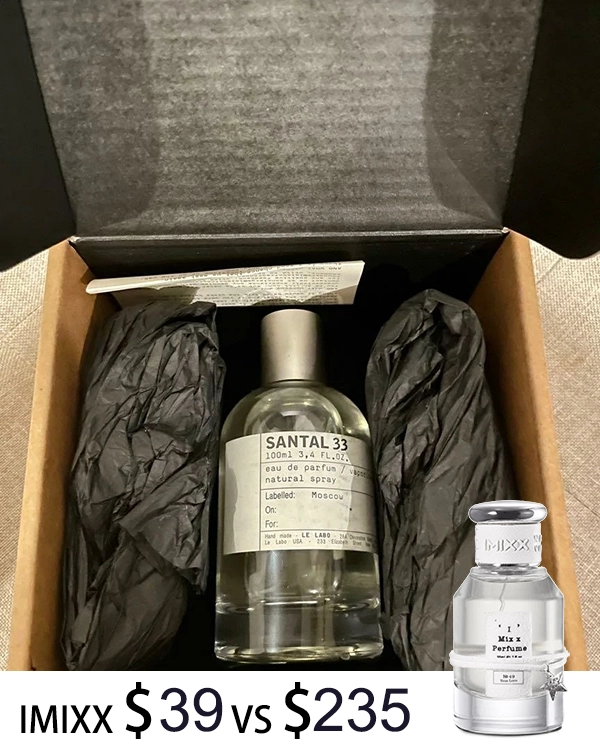

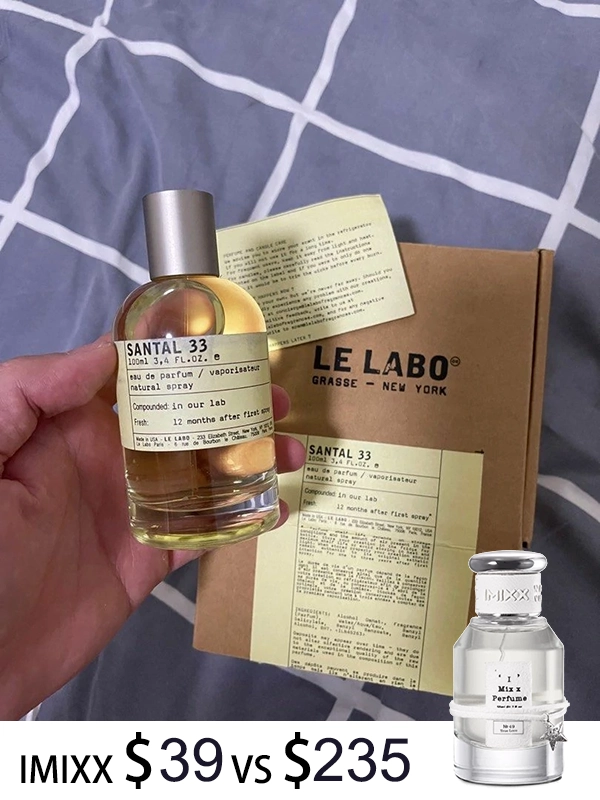
What Is santal.33 And Why Is It So Popular? 5 Reasons To Consider It
If I had to explain Santal 33 in one sentence, I would call it a dry, smoky, leathery sandalwood fragrance whose recognizable contrast between softness and sharpness helped define the modern niche-perfume aesthetic. I also think santal.33 became famous because it does something more interesting than simply smell “woody”: it combines cardamom, violet and iris effects with Australian sandalwood, cedarwood, leather-like facets and musk, so the scent can feel creamy, papery, smoky, green and slightly mineral at different moments.
For readers who are comparing the original with a lower-priced interpretation, I also cover santal.33 from a value perspective. I want to be explicit about the commercial context before I go further: I am writing for IMIXX Perfumes, and IMIXX sells No.62, an inspired-by fragrance built around a similar woody, violet, cardamom, orris, cedar, sandalwood and amber direction. That means I have a commercial interest in the alternative I discuss below. I do not present this page as independent buying advice, and I do not treat a proprietary similarity percentage or a fixed number of longevity hours as an independently verified fact.
How I Separate Facts, Interpretation, and Commercial Information
Verified product facts: I use primary or authoritative sources for the original fragrance’s note structure, perfumer attribution, launch year, and sandalwood chemistry.
My interpretation: When I describe a note as dry, smoky, creamy, papery, green or medicinal, I am describing an olfactory impression rather than a laboratory measurement.
IMIXX product information: Price, concentration and listed notes for No.62 are seller-published specifications. I present them as such and do not turn them into unsupported claims of identical formula, identical materials, or guaranteed wear time.
This approach is important because fragrance is unusually easy to overstate. A scent can last longer on one person than another; projection changes with dose and weather; and two people can interpret the same accord very differently. Rather than pretending I can reduce all of that to one “accuracy” score, I will show what is documented, explain what makes the structure distinctive, and give you a practical way to decide whether the scent profile suits you.
What Santal 33 Actually Smells Like
Le Labo’s current product description centers the fragrance on cardamom, iris and violet, then adds what the brand calls a smoking-wood combination of Australian sandalwood and cedarwood, together with spicy, leathery and musky facets. I use that as my starting point because it is more reliable than treating community note pyramids as if they were formulas. You can check the brand’s current description on the official Le Labo Santal 33 page.
To my nose as a writer analyzing this structure, the most important feature is contrast. Cardamom supplies aromatic lift and warmth. Violet and iris effects can make the opening feel cool, papery, powdery or faintly metallic. Cedarwood brings a dry, pencil-shaving character. Australian sandalwood reinforces the wood theme but does not necessarily read as the plush, sweet creaminess people sometimes associate with Indian sandalwood. The leathery and musky facets give the drydown body and persistence.
That tension is also why the fragrance can be polarizing. Some people describe a green or pickle-like association, while others never perceive it. I would not tell anyone that one interpretation is “correct.” Smell perception is partly associative: when a combination of woody, green, floral and aromatic materials resembles a familiar food, plant, cleaning product, paper, leather or place, the brain can attach that label quickly. Once the scent moves into its drier woody phase, that association may weaken or disappear for some wearers.
| Part of the scent | What is documented | How I would describe the effect | What to notice on skin |
|---|---|---|---|
| Aromatic opening | Cardamom | Warm, dry spice with a fresh aromatic edge | Whether the spice feels bright or quickly folds into the woods |
| Floral texture | Iris and violet notes | Powdery, papery, green, cool or slightly metallic | Whether this area reads elegant, vegetal or unusually sharp to you |
| Woody core | Australian sandalwood and cedarwood | Dry, smoky, creamy in places, with a pencil-like cedar effect | Whether sandalwood or cedar dominates after the opening settles |
| Dark accents | Spicy and leathery notes | Supple leather, smoke and warm shadow | Whether the drydown feels smooth or rugged |
| Base impression | Musky facets in the brand description | Warm, skin-like diffusion that softens the woods | How close the scent sits after the main projection fades |
Who Created Santal 33, and When Did It Launch?
Frank Voelkl is the perfumer associated with Santal 33. That attribution is stronger than a recycled blog claim: dsm-firmenich, the fragrance house where Voelkl is now a Master Perfumer, identifies Santal 33 among the major works from his long collaboration with Le Labo. The company’s published career material also places Santal 33 in 2011. I therefore treat “Frank Voelkl, 2011” as a sourced historical fact rather than as marketing folklore. Readers who want to verify the perfumer’s current professional status can see dsm-firmenich’s 2026 announcement about Frank Voelkl.
I find the fragrance’s place in the 2010s especially useful for understanding its popularity. It arrived at a moment when niche fragrance was becoming more visible to mainstream luxury consumers, minimalist packaging had cultural cachet, and many shoppers were looking beyond the traditional “for him” and “for her” fragrance counter. Santal 33 fit that moment without needing to smell conventionally fresh, conventionally sweet or conventionally formal. Its dry woods and leathery texture could feel contemporary precisely because they were not built around the familiar cues of blue aquatic masculines or syrupy floral gourmands.
I would still resist the temptation to claim that one perfume single-handedly “changed perfumery forever.” That phrase is catchy but hard to substantiate. A more defensible conclusion is that Santal 33 became an unusually recognizable reference point within modern woody fragrance, and its success helped make dry sandalwood, cedar, leather and violet combinations more culturally legible to a broad audience.
Why Australian Sandalwood Matters to the Scent Profile
The original article leaned heavily on molecular language, but technical vocabulary only improves expertise when the chemistry is stated carefully. Australian sandalwood is commonly identified botanically as Santalum spicatum. Peer-reviewed research shows that its heartwood oil contains a variable mixture of sesquiterpenes and that α-santalol and β-santalol are important fragrance-related constituents. Crucially, the composition can vary substantially between trees and regions. The study I reviewed reports 17 major sesquiterpene hydrocarbons and alcohols in its GC-MS analysis, not a generalized claim that every sample contains “more than 100 volatile compounds.” I consider that distinction important because it prevents scientific detail from becoming decorative exaggeration.
The same research also shows why Australian sandalwood should not be described as chemically interchangeable with Indian sandalwood. Santalum album typically has a higher combined santalol content, while Santalum spicatum can have a more variable sesquiterpene profile. If you want to examine the underlying chemistry rather than rely on perfume copy, the open-access paper “Sesquiterpene Variation in West Australian Sandalwood” is a useful technical reference.
Knowledge Point: Natural Material ≠ One Fixed Smell
I do not assume that the name of a botanical material tells me the exact odor profile of every batch. Natural extracts vary with species, geography, growing conditions, harvest, processing and composition. In finished perfume, those materials are also used inside a much larger formula. That is why I treat “Australian sandalwood” as an important structural clue, not as a complete explanation of the finished scent.
5 Reasons I Think Santal 33 Became So Popular
1. It Has a Highly Recognizable Woody Signature
The first reason is memorability. Many perfumes are pleasant but difficult to identify once they leave the blotter. Santal 33 has a more specific silhouette: aromatic spice, cool floral texture, dry cedar, smoky sandalwood, leather and musk. Even people who disagree about whether they love it can often agree that it has a distinct personality.
That recognizability matters socially. Fragrance is invisible, so a scent becomes culturally powerful when people can recognize it in elevators, restaurants, hotel lobbies, offices and on clothing. I would not turn anecdotes about strangers asking “what are you wearing?” into statistical evidence, but the broader mechanism makes sense: a distinctive odor profile is easier to remember, talk about and seek out than a generic “nice perfume” impression.
For SEO readers searching what santal.33 smells like, my concise answer is this: it is not a sweet sandalwood cloud. It is a dry woody composition with spicy, violet-like, leathery, smoky and musky contrasts. If you only like creamy vanilla-sandalwood fragrances, that distinction matters.
2. It Reads as Genuinely Gender-Open
I avoid inventing a “50/50 male-female wearer ratio” because I have not found a reliable public dataset supporting that exact number. What I can say is that the structure itself is easy to understand outside rigid gender categories. Cedar, sandalwood, cardamom, iris, violet, leather and musk have all appeared across fragrances marketed to different genders. Put together here, they produce a composition that many people can wear without the scent depending on a strongly gender-coded floral bouquet, sugary gourmand base or classic fougère structure.
That does not mean everyone will perceive it neutrally. One person may read leather and cedar as traditionally masculine; another may read iris, violet and creamy woods as softer or more elegant. I see that ambiguity as part of the appeal. Instead of asking “Is this for men or women?” I think the more useful question is “Do I like dry aromatic woods with a leathery, violet-toned edge on my skin?”
3. The Composition Changes Character as You Wear It
I am careful here because I do not have a documented, controlled months-long wear panel that would justify precise statements such as “the heart begins at 30 minutes” or “the base starts at exactly six hours.” Evaporation curves are not stopwatches. Dose, fabric, skin condition, ambient temperature, air movement and sensory adaptation all influence what you notice and when.
Still, the structure has enough contrast to create a clear sense of development. Early on, the aromatic cardamom and cool violet/iris effects can feel brighter and more angular. As those volatile impressions recede, the woody core becomes easier to focus on. Later, cedar, sandalwood, leather-like and musky facets can feel smoother and closer to the skin. I prefer to describe that evolution qualitatively instead of attaching false precision to it.
Key Point: I Do Not Promise a Universal Longevity Number
I would not publish “10–12 hours” as a fact for every wearer. Fragrance longevity depends on formula, dose, application surface, climate, skin condition and how quickly the wearer becomes nose-blind to the scent. For a useful test, I recommend measuring two things separately: how long you can smell the fragrance on your own skin at close range, and how long another person can detect its projection at a normal conversational distance.
4. It Fits Many Settings Without Smelling Generic
Another reason I think Santal 33 has stayed relevant is versatility. A dry woody fragrance can move between daytime and evening more easily than a very sweet gourmand, a dense animalic, or a bright beachy citrus. I can imagine the same scent profile working with denim and a T-shirt, office clothes, minimalist evening wear or a winter coat. That is not the same as saying it is perfect everywhere; heavy application in a small office or hot car can still be intrusive.
I also think the fragrance benefits from being distinctive without being obviously ceremonial. It does not smell like something that must wait for a formal event, and it does not depend on a bright sporty freshness that makes it feel casual only. That middle ground is useful for anyone trying to own fewer bottles and wear one signature scent in more situations.
5. It Became a Cultural Reference, Not Just a Bottle
Popularity feeds recognizability, and recognizability feeds popularity. Once a fragrance becomes associated with design-conscious spaces, fashion culture, hospitality, city life and niche perfume, people start encountering not only the smell but also stories about the smell. That social layer can magnify interest far beyond the formula itself.
I do not think cultural status automatically proves quality. Popular things can be overhyped, and famous fragrances can become tiring if you smell them everywhere. But cultural familiarity does change the purchase decision. Some shoppers want a scent with a known identity; others deliberately avoid it because they want something less recognizable. Both reactions are reasonable.
What I Would Test Before Buying a Full Bottle
Because this fragrance is polarizing, I would not make a full-bottle decision from a note list alone. I would test in stages. First, I would smell it on paper to understand the broad composition without skin. Second, I would wear one or two sprays on clean skin and leave the fragrance alone for several hours. Third, I would repeat on another day, ideally in different weather. This simple process tells me more than repeatedly smelling the same wrist every few minutes.
I would also avoid comparing multiple strong woody fragrances on adjacent patches of skin. Olfactory fatigue can make the later samples seem weaker or flatter, and cross-contamination can blur the differences. If I am comparing an inspired-by fragrance with the original, I prefer one fragrance on each arm at a matched spray count, then I note the opening, the middle of the wear, the late drydown, and projection separately.
| Test stage | What I record | Why it matters |
|---|---|---|
| 0–15 minutes | Aromatic spice, green/powdery effects, first impression | Shows whether the opening is enjoyable or merely tolerable |
| 1–3 hours | Wood balance, leather, dryness, projection | Often reveals the recognizable “identity” of the scent |
| Late drydown | Remaining sandalwood, cedar, musk, warmth | A fragrance can start beautifully but become generic later, or vice versa |
| Second wear | Whether the same associations repeat | Reduces the chance that one unusual day determines the purchase |
Original vs. IMIXX No.62: A More Transparent Comparison
Since this article appears on an IMIXX site, I think the comparison should be more transparent than a table that quietly gives the house product a 9/10 value score. I would rather show exactly what is known and what remains subjective. The original is the reference composition. IMIXX No.62 is an inspired-by interpretation that aims at a similar scent direction while using its own published note list and formula specifications.
Le Labo Santal 33
Role: The original composition discussed in this article.
Official profile: Cardamom, iris, violet, Australian sandalwood, cedarwood, spicy, leathery and musky facets.
What I would buy it for: The original formula, brand experience, provenance and reference-point status.
Performance: I recommend testing on your own skin rather than relying on a universal hour count.
IMIXX No.62
Role: An inspired-by alternative built for shoppers who want a related woody scent direction at a lower price.
Listed profile: Violet leaves, cardamom, orris, Ambrox, cedarwood, cypriol, musk, sandalwood and amber.
Current seller-listed price: $39 for 50 ml at the time I reviewed the page; prices and promotions can change.
Listed concentration: 25%. I treat this as a formulation specification, not as proof that it will last a fixed number of hours.
Similarity: Subjective. I do not present a percentage as independently verified.
My Buying Rule
If provenance and the exact original composition matter most to me, I choose the original. If budget matters more and I mainly want the recognizable dry woody-cardamom-violet direction, I compare an inspired-by option on skin. I would not tell readers that lower price automatically means equal quality, or that a higher fragrance concentration automatically guarantees longer wear. Those are separate questions that should be tested rather than assumed.
Does Santal 33 Last a Long Time?
I understand why longevity is one of the most searched questions around this fragrance, but I think the responsible answer is a range of possibilities rather than a promise. Strong woody materials and musky/amber-like base materials can create persistence, yet the exact experience depends on more than concentration. Spray volume matters. Skin hydration matters. Temperature and humidity influence diffusion. Fabric can retain aromatic materials differently from skin. Most importantly, the human nose adapts, so the wearer may stop noticing a scent that is still perceptible to someone else.
If I were reviewing performance properly, I would record dose, location, weather, and time, then ask a second person to check projection at intervals. I would also distinguish “skin scent longevity” from “room-filling projection.” A fragrance can remain detectable on the wrist for many hours while projecting only for a small part of that time. Combining those two concepts into one number is misleading.
For everyday use, I would start conservatively. Two sprays are enough to learn a lot about the fragrance. If it feels too quiet in your environment, increase gradually. If it becomes intrusive, reducing dose is more useful than blaming the perfume. This is especially relevant in offices, restaurants, airplanes and other shared spaces where strong fragrance can affect people nearby.
Is Santal 33 Really Unisex?
I consider “unisex” most useful as a shopping category, not as a chemical property. Molecules do not have gender, but fragrance traditions attach gendered associations to certain accords. Santal 33 works well outside those old categories because its main themes—wood, aromatic spice, violet/iris texture, leather and musk—do not force one conventional reading.
On one wearer, the cardamom and dry cedar may feel severe and tailored. On another, the violet, iris and smooth woody facets may feel softer. The same person may even perceive the fragrance differently in summer and winter because volatility and context change. I would therefore choose it based on taste rather than demographic labels.
Why Do Some People Say Santal 33 Smells Like Pickles?
This question deserves a better answer than “your skin chemistry is weird.” Olfactory perception works through pattern recognition. A perfume does not need to contain dill to remind someone of dill. A combination of green, aromatic, woody, floral and slightly sharp facets can trigger that association. Violet/iris effects and the drier character of the woods can make the opening feel unusual compared with sweeter sandalwood perfumes.
I would also avoid claiming that the effect disappears in exactly five or ten minutes. For some people it fades quickly; for others it remains part of the scent’s identity. If that association bothers you on first spray, give the fragrance a full wear before deciding, but do not assume you will eventually “learn” to like it. A polarizing association is a valid reason not to buy a fragrance.
When I Would Wear This Scent Profile
I see the dry woody profile as most natural in mild or cool weather, but I would not lock it to one season. In cooler air, the leather, wood and spice can feel more substantial. In warm weather, the same materials can diffuse faster and become more assertive, so I would use less. The absence of heavy syrupy sweetness helps, but that does not make any woody fragrance automatically heat-proof.
For work, I would apply lightly. For casual daytime wear, the scent’s dry texture can feel polished without seeming formal. For dinner or evening events, a slightly stronger application can emphasize the smoky and leathery side. I would be cautious at job interviews, medical settings, airplanes and fragrance-sensitive environments because any recognizable perfume can distract when the wearer cannot control other people’s sensitivity.
| Situation | How I would approach it | Reason |
|---|---|---|
| Office | 1–2 sprays | Dry woods can be polished, but over-application can dominate a shared room |
| Casual daytime | 2 sprays, then reassess | The scent has enough character to feel intentional without needing formal clothes |
| Evening | 2–3 sprays if the venue allows | Leather and smoky woods can become more expressive in a social setting |
| High heat / enclosed transit | Use less or skip | Heat can increase diffusion, and enclosed spaces make projection more intrusive |
How I Would Apply and Store Santal 33
I prefer a simple application method: spray onto clean, dry skin from a short distance and let it dry naturally. I do not think rubbing the wrists together “destroys the molecules,” a common perfume myth, but rubbing can spread the liquid, increase evaporation from friction and change how you experience the opening. The easiest approach is simply not to rub.
If skin is very dry, an unscented moisturizer can help create a more even surface for fragrance. I would not promise that it adds a specific number of hours. I would also be cautious spraying fragrance directly onto delicate, light-colored or easily stained fabrics. If I want fragrance on clothing, I test an inconspicuous area first.
For storage, I keep perfume away from heat, direct sunlight and repeated temperature swings. A bedroom drawer or closet is generally better than a sunny windowsill or a steamy bathroom. The goal is not ritual; it is simply to reduce the light and heat exposure that can accelerate chemical change over time.
Is Santal 33 Worth the Price?
I think “worth it” depends on what you are actually buying. With the original, you are not only buying a woody smell. You are buying the original composition, the Le Labo brand experience, packaging, retail service, provenance and the cultural value attached to a recognizable fragrance. Those elements matter to some buyers and not to others.
If my main goal is to own the original reference, I would save for the original or buy a smaller size rather than force a substitute into that role. If my goal is primarily olfactory—something in the dry cardamom, violet, cedar, sandalwood, leather and musk family—then comparing inspired-by fragrances can be rational. The key is to judge them as separate products rather than assume that a low-priced alternative is chemically identical.
That distinction also improves trust. I do not think a retailer should claim “99.98% similarity” as though it were a universal sensory truth unless the methodology, reference batch, analytical method, weighting, panel design and reproducibility are all available for independent scrutiny. Analytical similarity and perceived similarity are not the same thing. Gas chromatography can help characterize volatile compounds, but a consumer’s experience also depends on concentration, trace materials, thresholds, evaporation behavior and perception. For that reason, I prefer the plain-language phrase “inspired by a similar scent profile” and encourage side-by-side wear testing.
My Practical Decision Guide
I Would Consider Santal 33 If…
- I enjoy dry woods more than sweet gourmands.
- I like cardamom, violet/iris textures and leather accents.
- I want a recognizable, modern woody signature.
- I prefer fragrance that feels gender-open rather than traditionally coded.
- I am willing to test the polarizing green/woody opening on skin.
I Would Probably Skip It If…
- I mainly want sugary vanilla, fruit or gourmand sweetness.
- I dislike dry cedar, leather or medicinal/green associations.
- I want a very discreet skin scent from the first minute.
- I strongly prefer obscure fragrances that few people recognize.
- I cannot test before buying and know I am sensitive to polarizing woods.
Frequently Asked Questions About santal.33
What is Santal 33?
I describe Santal 33 as a woody eau de parfum created by Frank Voelkl and launched in 2011. Its official scent description emphasizes cardamom, iris, violet, Australian sandalwood, cedarwood, plus spicy, leathery and musky facets. The result is dry, smoky, aromatic and textural rather than simply creamy or sweet.
Why is Santal 33 so popular?
I think its popularity comes from a combination of recognizability, gender-open styling, a distinctive dry woody signature, versatility and cultural visibility. Its unusual contrast between cardamom, violet/iris, cedar, sandalwood, leather and musk makes it easy to remember even when people disagree about whether they like it.
Does Santal 33 smell like pickles?
Some people make that association and others do not. I interpret it as a perceptual response to the combination of green, aromatic, violet/iris and dry woody facets rather than evidence that the perfume literally contains dill. If you notice the association, test the full drydown before deciding whether it bothers you.
How long does Santal 33 last?
I do not give one guaranteed hour count because longevity varies with dose, skin condition, climate, application surface and olfactory adaptation. I recommend testing projection and close-to-skin persistence separately on your own skin rather than treating a single online number as universal.
Is Santal 33 for men or women?
I consider it gender-open. The main themes—woods, spice, violet/iris, leather and musk—can be read in different ways depending on the wearer and the observer. I would choose it based on whether you like the scent profile, not on a gender label.
What is the difference between Australian and Indian sandalwood?
They are different species with different and variable chemical profiles. Peer-reviewed research on Santalum spicatum shows lower and more variable santalol content than the standards commonly associated with Santalum album. In perfume, however, the finished smell depends on the whole formula, not on one raw material in isolation.
Is IMIXX No.62 identical to Santal 33?
I do not describe it as identical. IMIXX No.62 is an inspired-by product sold by the publisher of this article. It uses a related note direction, but similarity is a sensory judgment and should be evaluated side by side. I do not present a proprietary percentage as independent proof of identical smell or performance.
How many sprays should I use?
I would start with one or two sprays, especially in an office, warm weather or an enclosed setting. If that feels too quiet after a full wear, increase gradually. Dose has a major effect on projection, so I prefer controlled adjustment over a fixed “maximum” that pretends every sprayer and environment is identical.
Final Verdict: Why I Still Think Santal 33 Is Worth Understanding
I do not need to call Santal 33 perfect to explain why it matters. Its appeal comes from character. The fragrance puts dry woods, aromatic spice, cool floral texture, leather and musk into a structure that is easy to recognize and difficult to confuse with a generic sweet woody scent. Frank Voelkl’s authorship and the 2011 launch are well documented, and Le Labo’s own current description confirms the cardamom, iris, violet, Australian sandalwood, cedarwood, spicy, leathery and musky architecture that gives the perfume its identity.
I also think a better article about santal.33 should be honest about what it cannot prove. I cannot responsibly promise that it will last a specific number of hours on every person. I cannot claim that a retailer’s inspired-by fragrance is “99.98% similar” in the same sense that an independent sensory panel or publicly documented analytical protocol might. I cannot turn a seller’s commercial interest into neutral authority simply by writing in a personal-review voice.
What I can do is make the buying decision clearer. If you want the original formula, brand provenance and cultural reference point, choose the original after testing it on skin. If you want to explore a similar dry woody-cardamom-violet direction at a lower price, an inspired-by option such as IMIXX No.62 may be worth comparing, with the commercial relationship disclosed and the similarity judged by your own nose. That is a more useful standard than pretending one product must “win” for every reader.
My final view is simple: Santal 33 is popular because it is recognizable, flexible, gender-open, texturally distinctive and culturally visible. Its polarizing edges are part of the story, not a flaw that every wearer has to ignore. Test it slowly, pay attention to the drydown rather than only the first spray, and decide whether the scent’s dry sandalwood, cedar, violet, cardamom and leather tension feels compelling on you.