

What Do Peso Pluma Ella Baila Sola Lyrics Have To Do With Perfume? The Connection I Can Actually Defend
When I look at Peso Pluma Ella Baila Sola Lyrics, I do not see a hidden perfume advertisement or a coded fragrance story. I see a song about immediate attraction, social confidence, admiration, and the rush of noticing someone whose presence changes the atmosphere. That distinction matters to me because I would rather give readers a useful interpretation than stretch a popular song into a sales claim it cannot support.
If I arrive at fragrance through Peso Pluma Ella Baila Sola Lyrics, I treat the connection as editorial rather than official. I use the song as a mood brief, then translate that mood into practical fragrance language: bright or dark, dry or sweet, restrained or expressive, daytime or evening, close-wearing or more noticeable. I can then compare scent directions without pretending that Eslabón Armado, Peso Pluma, or the song officially endorses any IMIXX Perfume product.
What I Think “Ella Baila Sola” Is Actually About
My starting point is the song itself. I read “Ella Baila Sola” as a scene of fascination. The narrator notices a woman in a social setting and focuses on the way she looks, carries herself, and commands attention. The emotional engine is not perfume, independence, wellness, or self-care. It is attraction. The woman appears self-possessed and visually magnetic, while the narrator responds with admiration, confidence, flirtation, and a certain amount of youthful bravado.
That reading gives me a more precise fragrance brief. Instead of vaguely searching for a perfume that represents “freedom,” I can ask better questions. What type of scent feels polished when someone walks into a room? What kind of opening creates an immediate impression without becoming harsh? What kind of drydown feels warm, confident, or flirtatious at conversational distance? Those questions are subjective, but they are at least connected to the emotional content of the song.
I also keep the cultural scale of the song in perspective. “Ella Baila Sola” became a major crossover moment for contemporary música mexicana and helped introduce a broader global audience to a sound rooted in regional Mexican traditions. I do not need to turn that success into a perfume claim. For this article, its importance is that the song became a widely shared cultural reference. That makes it useful as a language for discussing mood, style, presence, and identity.
Why I avoid over-interpreting the lyrics
A weak version of this article would take every line and force it into a fragrance note: confidence becomes amber, romance becomes rose, nightlife becomes vanilla, and so on. I do not think that is credible. Notes do not have fixed emotional meanings, and song lyrics are not perfume formulas. I use a looser framework. I first identify the social and emotional cues I hear in the song, then I consider which fragrance structures can plausibly create a comparable impression for me.
The Real Peso Pluma–Fragrance Connection I Can Verify
There is a genuine connection between Peso Pluma and fragrance, but I keep it separate from “Ella Baila Sola.” In a 2025 interview about his work with YSL Beauty’s MYSLF fragrance, he discussed perfume as part of his personal routine and public style. I find that distinction valuable because it gives me a verified fragrance-related fact about the artist without pretending the earlier song was written about scent. Readers who want the artist’s own comments can review the 2025 Hypebae interview with Peso Pluma about YSL Beauty and fragrance.
For me, this improves the integrity of the topic. I can say two things at once: first, the song itself does not establish an official perfume connection; second, fragrance later became a documented part of Peso Pluma’s beauty and style conversation. Those facts do not need to be merged into a stronger claim than the evidence allows.
How I Translate the Song’s Mood Into Fragrance Language
Perfumery becomes more useful when I move beyond “smells good” and “smells expensive.” I pay attention to structure: the opening, the heart, the drydown, the level of sweetness, the texture of woods, the brightness of citrus, the density of amber, the lift of aromatics, and the way a fragrance seems to radiate in a particular environment. I also think about occasion. A scent that works beautifully outdoors on a warm afternoon may feel intrusive in a small office, while an understated woody composition may disappear in a loud nightlife setting.
When I use Peso Pluma Ella Baila Sola Lyrics as the mood reference, I hear a sequence: attention first, flirtation second, and memorable presence throughout. That does not dictate one note list. Instead, it gives me several legitimate directions.
| Song cue I notice | How I translate it | Fragrance directions I would sample | What I refuse to claim |
|---|---|---|---|
| Immediate attraction | A clear opening that registers quickly | Citrus, aromatic facets, bright fruit, crisp woods | That a note is scientifically proven to make someone attractive |
| Social confidence | Definition and presence without roughness | Dry woods, amber, spice, aromatic accords | That perfume guarantees confidence, status, or compliments |
| Flirtation | Warmth, contrast, and an inviting drydown | Fruit, soft florals, vanilla-like warmth, amber, musk | That a fragrance works as a universal aphrodisiac |
| Memorable style | A recognizable signature rather than maximum strength | Distinct woods, floral contrast, mineral or salty effects | That stronger automatically means more sophisticated |
Three IMIXX Perfume Directions I Would Compare for This Mood
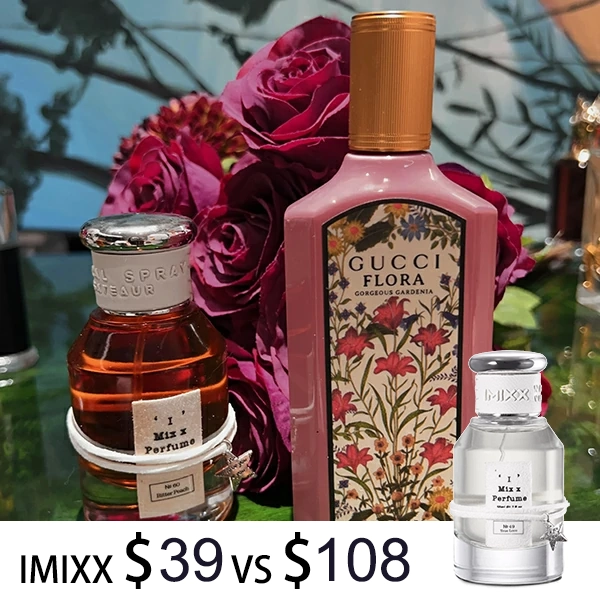
Because this page is commercial, I think the product section has to be unusually clear about its evidence level. I am not presenting these as official “Ella Baila Sola perfumes,” and I am not saying the artists endorse them. I am using three IMIXX Perfume listings as examples of different fragrance directions a reader could sample after identifying which part of the song’s mood matters most to them.
IMIXX No.48 — Inspired by Oud Wood
I would start here when I want to interpret the song’s confidence as composure rather than sweetness. The reference positioning points me toward a dry, polished, woody style that I associate with tailored evening wear and controlled presence.
When I would sample it: dinner, a dressed-up evening, a quiet date, or a setting where I want a defined but not sugary profile.
Possible mismatch: I would skip this direction if I mainly want juicy fruit, airy freshness, or an overtly floral signature.
What I would verify on skin: how dry the wood feels after 45–60 minutes, whether the spice becomes prominent, and whether the projection stays comfortable at conversation distance.
Evidence level: retailer product positioning plus my editorial mood match; no independent wear test presented.
IMIXX No.18 — Inspired by Lost Cherry
I would explore this direction when the part of the song I want to capture is playful attraction and social energy. A cherry-led reference suggests a richer and sweeter profile than the woody option, which makes it a more obvious candidate for nights when I want fragrance to feel expressive.
When I would sample it: a lively dinner, a party, a date night, or a colder-weather social event.
Possible mismatch: I would approach cautiously if I dislike sweet or fruit-forward fragrances.
What I would verify on skin: whether the fruit remains distinct after the opening, how the sweetness changes after an hour, and whether the base feels comfortable in warmer temperatures.
Evidence level: retailer product positioning plus my editorial mood match; longevity and resemblance are not independently verified here.
IMIXX No.51 — Inspired by Wood Sage and Sea Salt
I would choose this direction when I want the song’s confidence to feel relaxed instead of intense. The reference profile suggests a lighter mineral, herbal, and woody mood, which can make sense when I want presence without the density of a sweet evening fragrance.
When I would sample it: daytime dates, casual plans, spring or summer outings, and close indoor settings.
Possible mismatch: I would look elsewhere if I want a rich, enveloping, dessert-like scent.
What I would verify on skin: how long the bright opening remains distinct, whether the woody base is still noticeable later, and whether reapplication fits my routine.
Evidence level: retailer product positioning plus my editorial mood match; performance is not independently measured here.
My at-a-glance comparison
| Direction | Mood I assign it | When I would test it | Main uncertainty I would check |
|---|---|---|---|
| No.48 / woody | Reserved confidence | Polished evenings | Whether it feels too dry or restrained for me |
| No.18 / fruit-led | Flirtatious energy | Social nights out | Whether sweetness dominates the drydown |
| No.51 / fresh | Easygoing charisma | Daytime and warm weather | Whether it feels too subtle for my preferred projection |
My Comparison Method: What I Evaluate and What I Leave Unscored
One of the easiest ways to make fragrance content look authoritative is to add numbers. I could assign a similarity score, a compliment score, a “luxury” score, and an exact longevity figure. But if I have not collected the data under controlled conditions, the numbers create an illusion of precision rather than useful evidence. I prefer a structured qualitative method that tells readers exactly what I am looking for.
| Evaluation area | What I observe | Why it matters to me |
|---|---|---|
| Opening | The first 5–15 minutes: brightness, sharpness, sweetness, alcohol flash, dominant accord | It creates the first impression, but I do not mistake it for the full perfume. |
| Heart | How the scent changes after the initial volatility settles | This is where floral, aromatic, spicy, or fruity structure often becomes easier to judge. |
| Drydown | The character that remains later: wood, musk, amber, sweetness, powder, smoke, or mineral effects | I usually live with the drydown longer than the opening, so it matters more to my purchase decision. |
| Projection | How far the scent seems to travel under a specific set of conditions | A suitable office radius is not the same as a suitable outdoor or nightlife radius. |
| Longevity | How long I can perceive it when spray count and conditions are reasonably consistent | One person’s wear time is not a universal product constant. |
| Personal fit | Whether I actually want to wear the scent repeatedly | A technically impressive perfume still fails me if it does not fit my routine or preferences. |
Why I do not publish “99.98% similar” language
If I see a hyper-specific resemblance percentage, I want to know where it came from. Was the comparison performed by a trained sensory panel? Were participants blinded to brand and price? Was the opening evaluated separately from the heart and drydown? Were multiple bottles or batches tested? Was the result based on a chemical analysis, a consumer survey, a single reviewer, or a marketing estimate? Without a disclosed method, a number with two decimal places does not become more credible simply because it looks scientific.
I therefore use “inspired by” as a category description, not as a claim of chemical identity. Two fragrances can point in a similar direction and still differ in sweetness, diffusion, texture, balance, raw-material quality, development, and persistence. They can also smell more similar in the first five minutes than they do three hours later. I would rather state that uncertainty plainly than bury it under a score.
The Experience Gap: What I Know Without Pretending I Tested More Than I Did
E-E-A-T improves when I make the boundary of my experience visible. In this article, my experience is analytical and editorial: I interpret the song, organize fragrance families, compare retailer-stated product positioning, and build a practical sampling method. I do not claim a first-hand wear-test record that I have not documented. That means readers can use this page to narrow the field, but they should not treat it as a substitute for smelling the fragrances themselves.
If I later wanted to upgrade this article into a genuine empirical comparison, I would document the protocol before writing conclusions. I would identify each bottle and batch where possible, control spray count, use separate application points, keep other scented products out of the test, record temperature and setting, and repeat the comparison on multiple days. If I compared an inspired fragrance with its reference, I would avoid smelling them hours apart and relying on memory. I would test them side by side at the same checkpoints.
My repeatable at-home sampling protocol
- At application: I write down the first impression in ordinary language—crisp, dry, sweet, creamy, mineral, smoky, spicy, floral—before reading too much marketing copy.
- After 30–60 minutes: I check how the balance changes. I note whether the fragrance becomes smoother, sweeter, woodier, softer, or less distinct.
- After several hours: I assess the drydown and the practical wearing radius. I also account for nose fatigue, because repeated exposure can make me think a fragrance disappeared when I have simply adapted to it.
- On a second day: I repeat the process in reasonably similar conditions. I do not turn one hot afternoon, one dry-skin day, or one unusually cold evening into a universal performance claim.
- Before buying a larger bottle: I ask the most important question: do I actually want to reach for this again? That matters more to me than winning an abstract similarity contest.
Why Scent and Music Can Feel Connected Without an Official Tie-In
The most defensible bridge between music and perfume is memory and association. I can hear a song and immediately remember a trip, a relationship, a car ride, a club, a season, or a period of my life. Fragrance can work in a comparable way. A smell can become linked to a person, a place, a routine, or an event, and later act as a cue for that memory.
I also think it is important to avoid a simplified “smell is the strongest memory sense” slogan. A 2026 systematic review and meta-analysis of odor-evoked autobiographical memory found that odor cues showed advantages for some characteristics, including emotional intensity, pleasantness, evocativeness, and the age of memories, but the authors concluded that the olfactory advantage is selective rather than universal. That nuance is exactly what I want in an E-E-A-T-focused article. Readers can examine the PubMed record for the 2026 systematic review and meta-analysis.
In practical terms, I do not promise that wearing a particular fragrance while listening to a particular song will create a powerful memory. I only say that repeated combinations of scent, music, people, and place can become personally meaningful. That is why I find the song-to-scent idea more interesting as a ritual than as a literal product claim.
How I would build a personal song-to-scent association
If I wanted a fragrance to become linked with “Ella Baila Sola,” I would choose a scent I already enjoy and wear it repeatedly during a specific context: summer nights, concerts, weekend dinners, a vacation, or another recurring setting. I would not keep switching fragrances if my goal were association. Consistency gives the combination of scent and experience more opportunity to become familiar.
For me, that is more authentic than declaring that one bottle “is” the song. Songs become personal through experience. Fragrances do too. The retailer can suggest a direction, but the wearer creates the meaning.
How I Choose a Fragrance From the Song’s Different Emotional Angles
If I want confidence without heaviness
I begin with aromatic woods, fresh woods, dry woods, or mineral-woody profiles. I choose this lane when I want presence to come from shape and clarity rather than sweetness. This is the direction I would most readily wear to dinner, a smart-casual event, or a close social setting where I want fragrance to feel intentional but not theatrical.
If I want the flirtatious side
I test fruit, warm amber, soft florals, musks, and vanilla-like warmth. I am not looking for a magic attraction formula. I am looking for a texture that I personally read as warm, inviting, playful, or sensual. The difference matters: “this feels flirtatious to me” is an honest sensory judgment; “this makes people desire me” is an unsupported behavioral promise.
If I want a dramatic entrance
I move toward darker woods, richer amber, spice, smoky facets, leather-like effects, or dense floral contrasts. I usually reserve this direction for evenings or cooler weather because the added density can feel more assertive. I still prefer controlled application. Overspraying can make a sophisticated profile harder to appreciate, especially in restaurants, cars, offices, or other enclosed spaces.
If I want effortless daytime style
I lean toward airy woods, citrus, herbs, clean musks, salt-like effects, and translucent florals. This is the lane I choose when the part of the song I want is youthful social ease rather than nightlife intensity. It also tends to be easier for me to manage in warm weather and close indoor environments.
What “Inspired By” Means in My Buying Framework
When I see “inspired by,” I read it as a positioning statement. It tells me that the product aims at a recognizable fragrance direction or reference point. I do not read it as a statement that the product is made, licensed, or endorsed by the original fashion house. I also do not treat it as proof of formula identity.
That distinction helps me compare products on useful terms. I can ask whether the inspired fragrance evokes the reference style, whether I like its own drydown, whether the price is appropriate for my budget, and whether its wearing behavior fits my routine. I can prefer it, dislike it, or find it close enough for my purposes without turning my opinion into a chemical claim.
How I Think About Fragrance Safety Without Making Blanket Claims
I do not write that perfume dupes are automatically safe, and I do not write that prestige fragrances are automatically safer. Safety depends on formulation, concentration, intended use, manufacturing controls, applicable law, labeling, and the individual using the product. A fragrance that is compliant for its intended use can still be unsuitable for someone with a specific allergy or sensitivity.
When I discuss industry standards, I also avoid turning them into a certification claim they do not make. The International Fragrance Association explains that its standards can prohibit, restrict, or set specifications for fragrance materials, while also stating that a Certificate of Conformity to IFRA Standards does not replace a complete safety assessment. The organization further notes that companies remain responsible for applicable laws and regulations. I recommend reading the official IFRA Standards information for the technical framework.
A More Useful Way I Compare Value
Price is easy to compare; value is not. When I evaluate an inspired fragrance, I do not reduce value to “cheaper than the reference.” I look at whether I enjoy the scent, how often I would wear it, whether the bottle size suits my habits, how much I need to apply, and whether the style fills a real gap in my wardrobe. A lower price can be attractive, but a bottle I never reach for is still poor value.
I also distinguish between access and equivalence. An inspired fragrance can make a certain style more accessible to me financially without needing to be identical in every phase of wear. That is a more realistic buying proposition. It allows me to judge the product on what it actually does instead of forcing it to pass an impossible “perfect clone” test.
My five-question value check
I judge the phase I will wear longest, not only the first spray.
I consider work, dates, weather, travel, and close indoor spaces.
I value repeat wear more than novelty.
I do not need maximum projection if I prefer discretion.
I compare cost with expected wear, not with marketing prestige alone.
Why Personal Identity Is the Strongest Link Between the Song and Perfume
The deeper connection I see is identity construction. I use music to signal taste, community, mood, memory, and the scenes I feel connected to. Fragrance can work in parallel. I can wear something clean and restrained because I want to feel composed, something warm because I associate it with intimacy, or something loud because I want my style to feel more extroverted that night.
This is why a song-based fragrance article can still be genuinely useful even without an official collaboration. The song becomes a shared reference that helps me define a sensory brief. “I want confident but not loud” is actionable. “I want warm and flirtatious for an evening” is actionable. “I want the best perfume” is too vague to guide a meaningful choice.
At the same time, I do not want cultural relevance to become a shortcut for product promotion. If someone searches for Peso Pluma Ella Baila Sola Lyrics, the article should reward that search with a genuine discussion of the song before moving into commerce. I think that is the right SEO approach too: satisfy the intent, explain the bridge, disclose the commercial context, and give readers practical information they can use even if they never buy anything.
My Decision Guide: Which Fragrance Direction Would I Test First?
| If my priority is… | I would start with… | I would check… | I would avoid assuming… |
|---|---|---|---|
| Polished evening confidence | Woody / aromatic / dry amber | Smoothness, spice, conversation-distance projection | That dryness automatically means sophistication |
| Playful flirtation | Fruit / amber / soft floral / musk | Sweetness through the drydown | That sweetness guarantees compliments |
| Warm-weather ease | Fresh woods / herbs / mineral / citrus | Persistence and whether I enjoy reapplying | That lighter automatically means weak |
| A stronger nightlife statement | Dense amber / spice / dark woods | Dose, heat, and indoor comfort | That louder automatically means better |
FAQ: Peso Pluma, “Ella Baila Sola,” and Perfume
What do Peso Pluma Ella Baila Sola Lyrics have to do with perfume?
I do not treat the song as a literal perfume story. I connect it to fragrance through mood: attraction, confidence, flirtation, social presence, and memorable personal style. I then translate those ideas into scent families and wearing occasions while keeping the connection clearly editorial.
Is “Ella Baila Sola” officially connected to an IMIXX Perfume fragrance?
No official connection is presented in this article. My IMIXX Perfume suggestions are mood-based editorial pairings. I do not claim that Eslabón Armado or Peso Pluma endorses the products discussed here.
Does Peso Pluma have a documented connection to fragrance?
Yes. Separate from the song, he participated in YSL Beauty’s MYSLF fragrance campaign ecosystem and discussed his interest in perfume in a 2025 interview. I treat that as a verified artist-fragrance connection, not as evidence that “Ella Baila Sola” itself is about perfume.
Can scent really trigger autobiographical memories?
Research supports a relationship between odor cues and autobiographical memory, but I do not describe the effect as universal. A 2026 meta-analysis found advantages for some memory characteristics while concluding that the broader olfactory advantage is selective.
Are inspired perfumes automatically safe?
No fragrance category is automatically safe for every person. I look at labeling, intended use, applicable regulation, manufacturing controls, and individual sensitivities. I also avoid treating IFRA conformity as a substitute for a complete finished-product safety assessment.
How would I compare an inspired fragrance with its reference?
I would compare the opening, heart, drydown, projection, longevity, and overall wearability under similar conditions. I would repeat the test on more than one day and avoid turning my impression into an exact percentage unless a transparent testing method actually supports one.
Which IMIXX Perfume direction best matches the song for me?
I would choose based on the part of the mood I want to emphasize. I would test a woody direction for polished confidence, a sweeter fruit-led direction for flirtatious nightlife energy, and a fresh woody direction for relaxed daytime charisma.
Why do I avoid exact similarity percentages?
Because precision needs a method. Without a disclosed test design, sample size, evaluation criteria, repeated measurements, and clear definitions of what “similarity” means, a percentage can look more scientific than the evidence justifies.
Final Take: The Connection Works Best When I Keep It Honest
So, what do Peso Pluma Ella Baila Sola Lyrics have to do with perfume? Less than a promotional headline might suggest, but enough to create a useful sensory discussion. I hear a song built around immediate attraction, social confidence, admiration, flirtation, and the presence of someone who stands out. Fragrance gives me another vocabulary for exploring those ideas through woods, fruit, amber, florals, musk, freshness, warmth, and texture.
I also have a real, documented bridge between Peso Pluma and the fragrance world through his later work around YSL Beauty’s MYSLF. I keep that fact separate from the song. That separation makes the article stronger because I do not need to convert chronology into endorsement or coincidence into causation.
For an IMIXX Perfume shopper, my recommendation is straightforward: I would use the song to define the mood I want, then I would sample fragrances based on structure and real-life use. If I want woody confidence, I test a woody direction. If I want sweeter flirtation, I test a fruit-led or warm amber direction. If I want relaxed daytime energy, I test fresh woods, herbs, mineral effects, or citrus. I judge the drydown on my own skin, in my own climate, at a dose that fits my routine.
That approach is more credible than promising universal safety, perfect duplication, guaranteed attraction, or a made-up similarity percentage. It also respects both halves of the topic. The music deserves a faithful reading, and fragrance deserves evidence-aware language. When I connect them through transparent limits, practical sensory criteria, and clearly labeled interpretation, the article becomes more useful to readers and more defensible as search content.