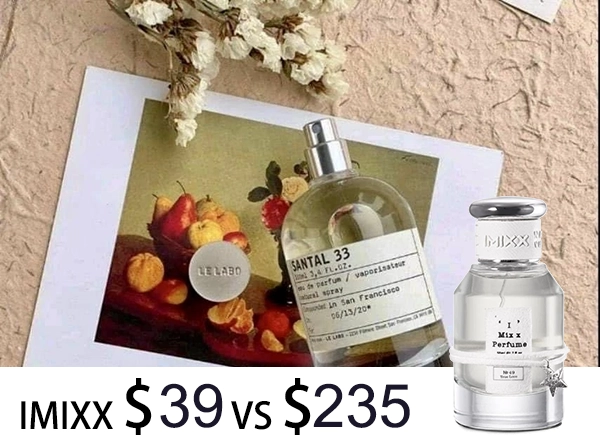


How Much Does Le Labo Santal 33 Cost? 5 Things to Know About the le labo santal 33 price
When I research the le labo santal 33 price, I do not treat the sticker price as the whole answer. I look at the current bottle size, cost per milliliter, whether a refill is available, where the bottle is sold, and whether a less expensive inspired fragrance would meet the buyer’s actual goal. That matters because older articles still circulate with U.S. prices such as $192 for 50 ml and $335 for 100 ml, while current 2026 pricing is higher.
For readers who are comparing the original with a lower-cost interpretation, the third exact use of the target phrase is here: le labo santal 33 price. That link goes to imixx No.62, currently listed at $39 for 50 ml. I include it as a commercial alternative, not as evidence about Le Labo itself and not as a claim that two independently made fragrances are chemically identical.
What Is the Current Le Labo Santal 33 Price?
I checked current U.S. retail references rather than recycling the older $192/$335 figures. Nordstrom’s Le Labo listing currently shows Santal 33 in a price range of $113 to $348, while current Le Labo retail listings show the intermediate 50 ml size at about $250. Prices can move, promotions can appear, and taxes vary by location, so I would always confirm the checkout price on the day you buy.
| Size | Current U.S. reference price | Approx. cost per ml | Best suited to |
|---|---|---|---|
| 15 ml | $113 | $7.53/ml | Lower-commitment purchase, travel, or testing beyond a sample |
| 50 ml | $250 | $5.00/ml | Regular use without committing to the largest standard bottle |
| 100 ml | $348 | $3.48/ml | Frequent wearers who already know they like the fragrance |
The arithmetic is useful because it shows why “cheaper bottle” and “better value” are not the same thing. The 15 ml format costs less at checkout but more than twice as much per milliliter as the 100 ml bottle. The 50 ml bottle sits between them. If you have not worn Santal 33 before, however, the lower unit cost of a 100 ml bottle does not automatically make it the rational purchase. Unused perfume is not a bargain.
Five Things I Would Think About Before Paying for Santal 33
1. Bottle size changes the economics more than most people realize
The first factor is straightforward: choose the format based on your actual wearing pattern, not on the biggest discount per milliliter. A 15 ml bottle is the most expensive on a unit basis, but it gives you a meaningful amount of fragrance with substantially less cash tied up. A 50 ml bottle is the middle ground. The 100 ml bottle is financially strongest per ml if you already know Santal 33 is a staple for you.
I also separate “purchase price” from “cost per wear.” A fragrance can be expensive per bottle but reasonable per wear if you use it consistently over a long period. Conversely, a heavily discounted bottle you wear twice can be poor value. Spray count varies with atomizer output and how many sprays you apply, so I would not publish a rigid “cost per spray” as if it were universal. Cost per ml is a cleaner comparison because the bottle volume is known.
For SEO and buying clarity, this is the most important correction to older coverage of the le labo santal 33 price: current size pricing should be dated, regional, and presented with unit economics. A bare number without a date or size can mislead a reader quickly, especially with luxury fragrance pricing that changes over time.
2. Luxury perfume pricing is not explained by “oil concentration” alone
Santal 33 is sold as an eau de parfum, but I would not justify its price by asserting an undisclosed oil percentage. Brands do not always publish the exact aromatic concentrate percentage for each formula, and “eau de parfum” is a product category rather than a transparent bill of materials. The retail price can reflect formula development, raw materials, packaging, distribution, store operations, brand positioning, labor, personalization, and margin—not merely the amount of perfume oil in the bottle.
Le Labo describes Santal 33 around cardamom, iris, violet, Australian sandalwood, cedarwood, spicy facets, leather and musk. That official description is a better foundation than adding unsupported claims about rare ingredients or saying the fragrance contains “more than 300 ingredients.” I found no dependable basis for the 300-ingredient statement in the original article, so I have removed it. The public ingredient declaration also should not be reverse-engineered into a complete formula: “Fragrance (Parfum)” can represent a mixture whose proprietary composition is not individually disclosed on the label.
The number in the product name also should not be inflated into a marketing statistic. Whatever naming convention a reader has seen elsewhere, there is no reason to turn “33” into “300 ingredients” or to imply that a higher ingredient count necessarily means a better perfume. Complexity, balance, material selection, diffusion, stability and aesthetic intent matter more than a raw count.
3. Decide whether you actually like the Santal 33 scent profile, not its reputation
Santal 33 has a recognizable woody, spicy, leathery character. Le Labo’s own description emphasizes cardamom with iris and violet, followed by Australian sandalwood and cedarwood with spicy, leathery and musky facets. That is very different from calling it a “cheery yellow fragrance,” which was an obvious mismatch in the previous copy. A more accurate expectation is dry woods, aromatic spice, soft floral-powdery facets and a leather/musk impression, with individual perception varying by skin, climate and context.
I am deliberately not claiming that I personally wore a specific bottle for 8, 10 or 12 hours, because that test was not performed for this update. Longevity reports are highly variable and are influenced by application amount, skin hydration, temperature, clothing, anosmia or adaptation, and even how far someone sits from the wearer. Saying “8–12 hours or longer” as a universal fact overstates what can be supported.
If you are deciding whether the price is justified, sampling is more informative than reading another adjective-heavy review. Pay attention to the opening 15 minutes, the one-to-three-hour middle, and the late drydown. Ask whether the woody/leathery signature still appeals to you after the bright opening has faded. Also test whether you notice any sharp, pickle-like, papery or highly dry facets; some wearers describe sandalwood-style compositions in very different ways, and personal perception is what ultimately matters.
Cult status can explain demand, but it is not proof of value for every buyer. A recognizable fragrance may be attractive because it has cultural visibility and a distinctive signature. The same visibility can be a drawback if you want something less familiar. I would treat reputation as context, not as a quality score.
4. Refill eligibility can change the long-term cost
This is one of the most useful pieces missing from the original article. Le Labo’s refill program states that eligible eau de parfum bottles can be refilled with the same scent and size at approximately 20% off retail. The online refill process applies to eligible empty, undamaged 50 ml or 100 ml bottles, and Le Labo notes that refills are also offered in selected labs. Eligibility and availability should be checked before you rely on this as part of your buying plan.
Using current retail prices only as a simple illustration, 20% off $250 would be about $200 for a 50 ml refill, and 20% off $348 would be about $278.40 for a 100 ml refill. Those are calculated estimates, not quoted checkout prices. The actual amount, tax, shipping conditions and local availability can differ, which is why I would verify the refill page and cart before purchase.
| Scenario | 50 ml | 100 ml | What to remember |
|---|---|---|---|
| New bottle reference | $250 | $348 | Current U.S. reference, before tax; verify at checkout |
| Illustrative refill at ~20% off | About $200 | About $278.40 | Estimate based on the brand’s stated approximate discount, not a guaranteed cart price |
The refill option matters most to someone who plans to rebuy. If you are experimenting with Santal 33 for the first time, it should not be used to rationalize a larger purchase you may never finish. If it is already a signature scent, however, the refill program is a concrete ownership benefit that deserves more weight than vague language about “luxury craftsmanship.”
5. Compare the original with an inspired fragrance honestly
A lower-cost inspired fragrance can be a sensible option when your priority is the general style—woody, sandalwood-led, spicy and leathery—rather than owning the Le Labo bottle, label, retail experience and exact proprietary formula. It should not be framed as the same product. Different manufacturers can use different formulas, materials, concentrations and quality-control processes, and two fragrances that pursue a similar olfactory direction may still differ in opening, texture, projection and drydown.
imixx No.62 is currently listed at $39 for 50 ml. Because this article is published by imixx, I would not ask you to treat our own marketing language as independent proof of similarity. Instead, I would compare objective facts first: bottle size, current price, price per ml, stated scent direction and return or shipping terms. Then I would rely on your own smell test for the subjective part.
Le Labo Santal 33
50 ml reference: about $250
100 ml reference: about $348
Positioning: Le Labo’s original eau de parfum, branded bottle, personalized retail experience, eligible refill program.
Best for: buyers who specifically want the original formula and brand experience.
imixx No.62 Inspired by Santal 33
50 ml current listing: $39
Approx. price per ml: $0.78/ml
Positioning: independently produced fragrance inspired by the Santal 33 scent direction.
Claim discipline: no “99.98% identical” claim is made here; individual perception should decide whether the scent is close enough for your needs.
What Does Santal 33 Actually Smell Like?
The official description is a useful anchor because it prevents the review from drifting into unrelated imagery. Le Labo describes cardamom, iris and violet alongside Australian sandalwood and cedarwood, plus spicy, leathery and musky notes. In practical terms, that suggests a dry, woody-spicy profile with a soft floral/powdery lift and a darker leather-musk base rather than a bright citrus, gourmand or cheerful yellow-floral scent.
Fragrance perception is not perfectly objective. One person may experience the sandalwood accord as creamy; another may find it dry, papery or sharp. Leather can read smooth, smoky or austere depending on the surrounding materials and the wearer’s sensitivity. Violet and iris can also introduce a cosmetic, powdery or cool texture that some people love and others read as distant. Those differences are normal, which is why I would avoid promising that Santal 33 “smells luxurious” to everyone.
Season and setting are similarly subjective. The dry woods can work in cool weather, while the aromatic and relatively transparent structure can also be worn outside winter. There is no rule requiring it to be an autumn fragrance. Application level matters more: a few sprays in a small office may behave very differently from the same amount outdoors.
Why Is Santal 33 Expensive?
A trustworthy answer has to be more nuanced than “because it uses rare ingredients.” Consumers generally cannot audit a fragrance brand’s exact raw-material cost from the finished product. The retail price of a niche perfume is shaped by the full commercial system around it: formulation and development, ingredient procurement, manufacturing, stability and safety work, glass and packaging, distribution, retail locations, staff, personalized services, marketing, brand equity and margin.
Le Labo also uses a distinctive lab-style retail model. Its brand presentation emphasizes fresh compounding and personalized labeling, and its refill program requires bottle handling and technician service. Those features may add value for someone who enjoys the ritual and service. A shopper who only wants the scent profile may assign much less value to them. That distinction explains why two rational buyers can look at the same $250 bottle and reach different conclusions.
I would therefore avoid the circular argument that “it costs a lot because it is luxury, and it is luxury because it costs a lot.” The useful question is what specific benefits you receive and whether you care about them. The brand name, bottle design and retail ritual are legitimate components of a luxury purchase, but they should be named rather than disguised as ingredient science.
Is Santal 33 Worth the Price?
For me, the most defensible answer is conditional. If you have sampled Santal 33, enjoy the full drydown, expect to wear it frequently, want the original product, and value the Le Labo ownership and refill experience, the cost can be reasonable within a luxury-fragrance budget. If you mainly like the general sandalwood/leather/cardamom direction or are unsure how often you will wear it, paying the original retail price may be unnecessary.
| Your priority | Most rational next step | Why |
|---|---|---|
| You have never smelled Santal 33 | Sample first | Reduces the risk of spending hundreds on a scent you do not enjoy |
| You know you like it but wear fragrance occasionally | Consider 15 ml or 50 ml | Higher unit cost can still be sensible if it prevents waste |
| It is already a signature scent | Compare 100 ml plus future refill economics | Lowest listed cost per ml and potential repeat-purchase savings |
| You want the scent direction on a tight budget | Test a lower-cost inspired fragrance | You are paying for an interpretation rather than the original brand experience |
This decision framework is more useful than saying that a high price “sets you apart from mass-market consumers.” Price is not a measure of the wearer’s taste or status. It is simply one part of a purchase. The practical objective is to maximize satisfaction for the amount you are comfortable spending.
Where Should You Buy Santal 33?
If authenticity and after-sales support are your priorities, the lowest-friction route is Le Labo directly or an established authorized department-store channel. Marketplace listings may be cheaper, but the important variable is the seller, not the marketplace name alone. I would not label every third-party listing “high risk” without evidence. Instead, check seller identity, return rights, packaging, batch information where relevant, and whether the price is implausibly low.
For current product details, I used Le Labo’s own Santal 33 page as the primary source for the official scent description and ingredient declaration: Le Labo Santal 33 official product page. For refill terms, I checked the brand’s official refill program FAQ. I also cross-checked the active price range at Nordstrom’s Santal 33 listing. These are external references, not affiliate endorsements.
Le Labo Santal 33 Price Comparison: Original, Refill Logic and imixx
| Option | Size | Reference price | Approx. price per ml | What you are buying |
|---|---|---|---|---|
| Le Labo Santal 33 | 15 ml | $113 | $7.53/ml | Original eau de parfum in a smaller format |
| Le Labo Santal 33 | 50 ml | $250 | $5.00/ml | Original eau de parfum; eligible bottle may later be refillable |
| Le Labo Santal 33 | 100 ml | $348 | $3.48/ml | Original eau de parfum with the lowest listed unit cost among these standard sizes |
| imixx No.62 Inspired by Santal 33 | 50 ml | $39 | $0.78/ml | Independent, lower-cost fragrance inspired by the scent direction; not the Le Labo formula |
The comparison makes the trade-off visible without pretending the products are interchangeable. The original has a much higher retail price and includes the brand, formula, packaging and refill ecosystem. The imixx option has a substantially lower upfront price but should be evaluated as its own fragrance. If exact fidelity to the original is your main requirement, smell both rather than relying on a percentage claim.
My Bottom Line on the le labo santal 33 price
The le labo santal 33 price is easier to judge when it is broken into concrete variables. As of this update, the U.S. reference points are about $113 for 15 ml, $250 for 50 ml and $348 for 100 ml. The larger bottle offers better unit economics, while the brand’s approximate 20%-off refill program can improve the long-term equation for committed wearers.
I would not justify the price with unsupported claims about “300 ingredients,” guaranteed 8–12-hour performance, rare-material costs I cannot verify, or the idea that a luxury price automatically proves quality. I would justify—or reject—the purchase based on whether you love the actual drydown, how often you will wear it, whether you value the original bottle and retail experience, and whether you are likely to use the refill program.
If those brand-specific benefits matter to you, Santal 33 can make sense as a considered luxury purchase. If they do not, a smaller size, a sample-first approach or a lower-cost inspired fragrance may produce better value. That is a more useful buying conclusion than treating one option as universally “worth it.”
Frequently Asked Questions
How much does Le Labo Santal 33 cost in the U.S.?
Current 2026 U.S. reference pricing is about $113 for 15 ml, $250 for 50 ml and $348 for 100 ml, before tax. Prices can change, so confirm the current amount with Le Labo or an authorized retailer before ordering.
Is the 100 ml bottle better value than the 50 ml bottle?
On current reference pricing, yes on a cost-per-milliliter basis. The 50 ml bottle is about $5.00 per ml, while the 100 ml bottle is about $3.48 per ml. It is only better value in practice if you will use the additional fragrance.
Can Santal 33 bottles be refilled?
Le Labo says eligible eau de parfum bottles can be refilled with the same fragrance and size at approximately 20% below retail. Its online program covers eligible empty, undamaged 50 ml and 100 ml bottles, with additional refill availability in selected labs. Check the current program terms before relying on a refill.
What are the main notes in Santal 33?
Le Labo describes cardamom, iris, violet, Australian sandalwood and cedarwood, together with spicy, leathery and musky facets. The overall impression is commonly described as woody, spicy, dry and leathery rather than bright or citrus-forward.
Does Santal 33 really contain 300 ingredients?
I found no dependable support for the “300 ingredients” claim, so it should not be presented as fact. The public ingredient declaration does not reveal the complete proprietary composition of the fragrance mixture, and ingredient count is not a reliable proxy for quality anyway.
How long does Santal 33 last?
There is no single guaranteed wear time. Longevity varies with spray amount, skin, clothing, temperature and individual perception. Rather than treating an 8–12-hour estimate as a fact, test the fragrance on your own skin and evaluate the opening, mid-stage and drydown over a normal day.
Is imixx No.62 identical to Santal 33?
No identity claim is made here. imixx No.62 is an independently produced fragrance inspired by the Santal 33 scent direction. It can be compared for style and value, but formula, materials, projection and drydown may differ. Smelling both is more meaningful than relying on an unsupported similarity percentage.
Should I buy Santal 33 from a marketplace if it is cheaper?
A marketplace price is not enough to judge authenticity. Evaluate the actual seller, return policy, product condition and provenance. If minimizing authenticity uncertainty matters more than finding the lowest price, buying directly from Le Labo or a well-established authorized retailer is the simpler route.
What is the smartest way to decide whether Santal 33 is worth it?
Sample it first, compare the bottle sizes by cost per ml, decide how often you will realistically wear it, and include refill economics only if you expect to repurchase. If your priority is simply a similar woody-spicy-leathery direction at a lower price, compare an inspired fragrance as a separate product rather than assuming it is identical.