

How to Decide If Le Labo Baie 19 Is Right for You in the USA: A Perfumer’s Guide to Petrichor, Notes, Longevity, Seasons, and Smarter Alternatives
If you are researching Le Labo Baie 19 in the USA, I think the most useful question is not simply, “Does it smell like rain?” I would ask something more practical: what creates that rain-on-dry-earth illusion, how does the scent develop from opening to drydown, who is likely to enjoy it, and how should you judge value without relying on marketing percentages? That is the perspective I use throughout this guide.
For readers who already know that this green, mineral scent family suits them, Le Labo Baie 19 is also the reference point behind IMIXX No.63. I am linking that product page here before any outside source because this article is published by IMIXX and the commercial relationship should be obvious, not hidden. My goal is not to tell you that an inspired fragrance is “identical.” My goal is to explain how I evaluate the scent architecture, which product facts I can verify, where subjective judgment begins, and what I would want a USA shopper to test before spending money.
Editorial and E-E-A-T disclosure
I am writing from the IMIXX fragrance-development and manufacturing perspective. IMIXX sells No.63 Inspired by Baie 19, so I have a commercial interest in this scent category. I therefore separate four kinds of information throughout this article: publicly verifiable facts, first-person formulation/manufacturing analysis, customer-reported experience, and claims that have not been established by a controlled test. I do not use an unexplained similarity percentage, a fictional blind test, or an unsupported lab result as proof of quality.
My Short Answer: Who Is Le Labo Baie 19 Actually For?
I describe Baie 19 as a green, earthy, mineral, ozonic, woody-musky petrichor fragrance. It is not a conventional citrus aquatic and it is not a sweet “clean” perfume. The core sensation is closer to wet leaves, dry juniper, damp soil, cold air, rain-darkened stone, patchouli, transparent woods, and skin musk. If you like the smell of a garden, sidewalk, forest floor, or desert ground immediately after rain, the concept makes intuitive sense. If you mainly want vanilla, fruit, caramel, creamy florals, or a bright marine cologne, I would sample before buying.
| Decision factor | What I would expect from Baie 19 | What that means for a USA buyer |
|---|---|---|
| Scent family | Green, earthy, aromatic, ozonic, woody, musky | More atmospheric than traditionally “fresh” |
| Signature image | Petrichor, wet leaves, mineral air, damp ground | Useful if you want a perfume that smells like rain rather than the ocean |
| Key note language | Juniper berry, patchouli, green leaves, woody-musky diffusion | Expect dryness, greenery and earthiness rather than sweetness |
| Gender | Unisex | A strong option for shoppers who dislike rigid gender categories |
| Best seasons | Spring, fall, mild summer days; usable year-round | Climate and spray count matter more than a calendar rule |
| Blind-buy risk | Moderate | Patchouli, mineral and ozonic effects can be polarizing |
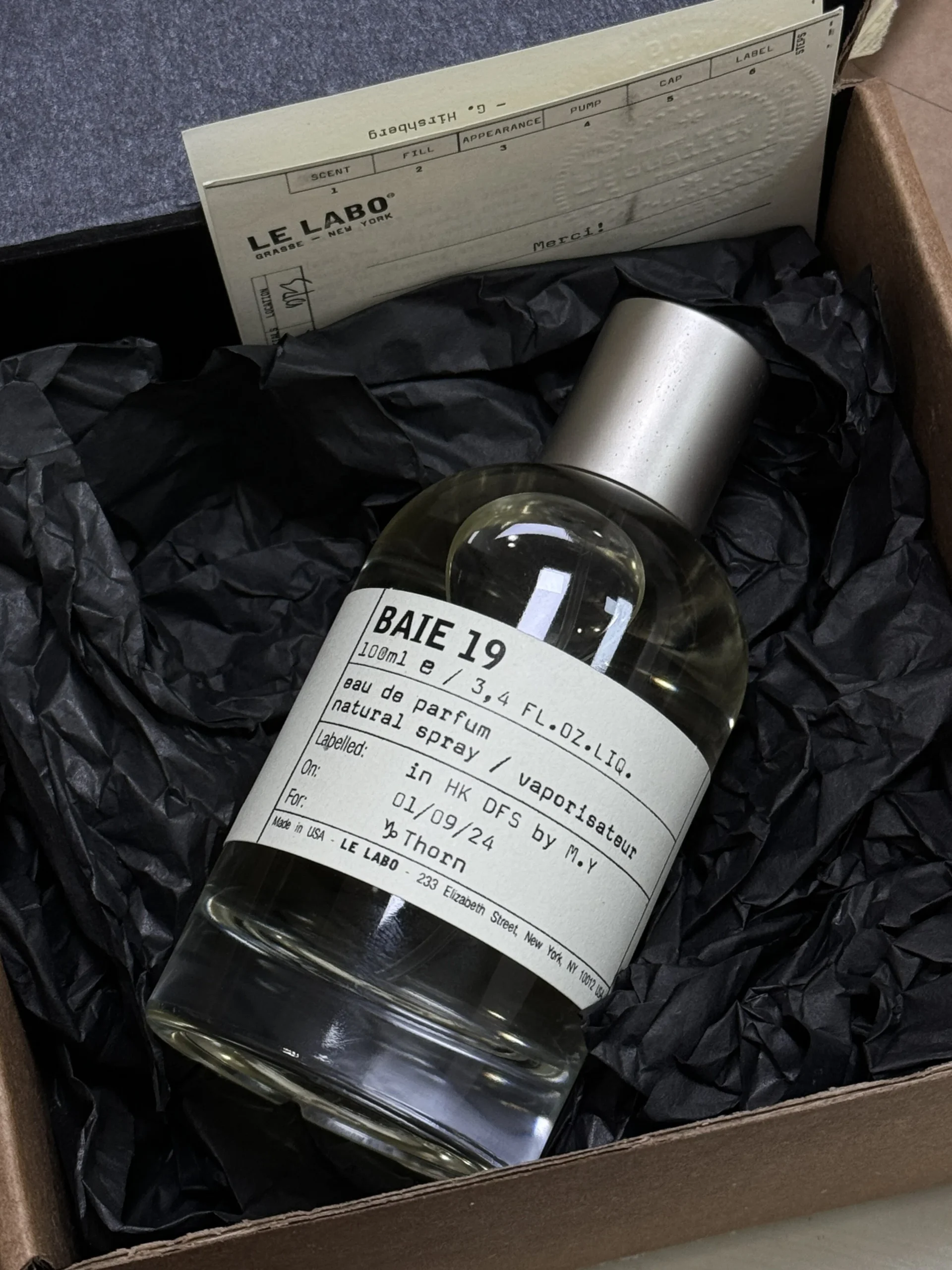
How I Read the Baie 19 Scent Structure: Wet and Dry at the Same Time
The most interesting thing about the Baie 19 scent profile is the contradiction. People describe it as wet, but much of the structure feels dry. They call it clean, yet patchouli introduces an earthy root-like darkness. They call it fresh, but citrus is not the main story. They call it aquatic, but it does not smell like a standard blue marine fragrance. To me, that tension is the entire point.
The official brand description centers on the “crisp, drenched effect” created when rain follows a long dry spell, which is why petrichor is the right conceptual framework. You can read the brand’s own description on the official Le Labo Baie 19 page. I use that as a source for the product’s intended olfactory story, not as proof of how every person will perceive it.
The opening: dry juniper, cool air and mineral sharpness
When I analyze a rain-style accord, I do not look for “water” as one note. I look for contrast. Dry aromatic materials can make surrounding green or ozonic materials feel wetter. Juniper is particularly useful because it can read as crisp, resinous, evergreen, peppery, gin-like or cold without becoming a conventional lemon opening. In the Baie 19 idea, that dryness creates the visual impression of air moving across wet surfaces.
This is also where some people encounter the “metallic” side of the fragrance. I would not automatically interpret metallic as a defect. In an atmospheric perfume, a cool mineral edge can be part of the realism. The question is whether you personally read that effect as storm air and wet concrete or as clinical and synthetic. That is a preference question, not a universal quality score.
The middle: green leaves and patchouli as landscape
Patchouli is often misunderstood because consumers associate it with dark, sweet, incense-heavy perfumes. In a green composition, I use patchouli conceptually in a different way: it can represent the soil beneath the foliage. Pair it with a brighter green effect and the patchouli can feel less like a “patchouli perfume” and more like damp roots, wet bark, leaf litter and earth after rain.
That distinction matters for long-tail searches such as wet earth perfume, perfume that smells like rain, forest after rain fragrance, green patchouli perfume, mineral perfume, rainy day perfume and petrichor fragrance. Those phrases describe the sensory problem better than simply calling Baie 19 aquatic.
The drydown: transparent woods, musk and the memory of rain
A good atmospheric composition cannot stay in “special effect mode” forever. If the wet-soil illusion remained literal and forceful for eight hours, it could become exhausting. The more wearable solution is to let the opening image dissolve into woody, musky and ambery transparency. That transition is why some wearers describe Baie 19 as strange in the first minutes but elegant later.
Knowledge point: “notes” are not the formula
When I say juniper, patchouli, green leaves, wet earth or mineral air, I am describing an olfactory effect. A marketing note list is not a complete chemical formula, and an ingredient declaration is not the same thing as either one. Two fragrances can advertise the same notes and smell very different because dosage, raw-material quality, volatility, diffusion and supporting materials change the architecture.
What Petrichor Really Means—and Why Baie 19 Does Not Literally Bottle Rain
I think the science of petrichor makes the fragrance easier to understand. The American Chemical Society explains that the characteristic smell after rain involves materials associated with soil and plants, including geosmin, and that rain can aerosolize odor-bearing material from porous surfaces. In other words, the smell we call “rain” is partly the environment reacting to water.
That idea is crucial in perfumery. I do not need a perfume to reproduce every molecule found above a wet patch of soil. I need the composition to trigger the same perceptual memory. Perfumery often works by suggestion: a dry aromatic note can imply moving air, a green accord can imply crushed vegetation, patchouli can imply soil, and transparent woody-musky materials can create space around the accord.
The Smithsonian also notes that humidity, temperature, soil, vegetation, built surfaces and individual perception all influence the smell associated with rain. That helps explain something I consider important for USA fragrance buyers: “petrichor” is not one fixed smell. Rain over pine needles in the Pacific Northwest does not smell exactly like rain over hot pavement in New York or a desert surface in Nevada.
My practical interpretation
When I evaluate a petrichor perfume, I ask whether the fragrance creates a believable relationship between air, vegetation, mineral surfaces and earth. I do not ask whether it contains “real rain.” That is why I consider Baie 19 an olfactory reconstruction of the experience around rainfall rather than a literal copy of rainwater.
What Are the Main Baie 19 Notes, and What Do They Actually Do?
For people searching Baie 19 notes, Baie 19 ingredients, what does Baie 19 smell like, juniper berry perfume, patchouli rain perfume or green unisex fragrance, I prefer to translate note language into function. That is more useful than presenting a decorative fragrance pyramid.
| Element | Role in the structure | What you may perceive | Why it matters |
|---|---|---|---|
| Juniper berry | Dry aromatic lift | Evergreen, cool berries, gin-like dryness | Keeps the opening fresh without becoming a lemon cologne |
| Green-leaf effect | Vegetal freshness | Wet foliage, stems, garden leaves | Connects the “rain” idea to living vegetation |
| Patchouli | Earth and depth | Damp soil, roots, wet wood | Prevents the fragrance from becoming a generic clean scent |
| Ozonic/mineral effect | Space and atmospheric tension | Cold air, storm edge, wet stone | Creates the sensation of environment rather than a single object |
| Woody-amber diffusion | Radiance and structure | Dry wood, clean warmth, mineral persistence | Carries the scent after the wetter illusion fades |
| Musk | Softness and continuity | Clean skin, fabric, quiet warmth | Makes an abstract rain concept easier to wear |
Why I Do Not Call Baie 19 a Typical Aquatic Perfume
A conventional aquatic fragrance often signals freshness through bright citrus, marine effects, watery florals, salt, melon-like transparency or familiar “blue” aromatics. Baie 19 points somewhere else. Its freshness comes from land after water: wet vegetation, soil, stone, air and dry aromatic contrast.
Typical marine freshness
The image is water itself: sea air, salt, citrus, transparent floral or “blue” cleanliness. The message is, “I am near water.”
Baie 19-style petrichor freshness
The image is the landscape after water arrives: wet earth, crushed leaves, mineral surfaces, cool air and aromatic dryness. The message is, “Water just changed the world around me.”
That is why search terms such as perfume that smells like rain, petrichor perfume, wet earth perfume, wet soil fragrance, rain-soaked forest scent, mineral fragrance, rainy day fragrance and green niche perfume are semantically closer to the experience than the broad label “aquatic.”
How Long Does Baie 19 Last? I Separate Longevity, Projection and Sillage
The question “how long does Baie 19 last?” looks simple but usually produces low-quality answers. I do not think an honest reviewer should give one universal hour count unless the test conditions are documented. Longevity, projection and sillage are related, but they are not the same measurement.
- Longevity is how long the fragrance remains detectable.
- Projection is how far the scent radiates from the wearer at a given point in time.
- Sillage is the trail a fragrance leaves as a person moves through space.
A fragrance can remain on clothing after its projection has become quiet. It can also open loudly and then settle close to the skin while still being detectable for hours. When I see a review reduce all three ideas to “lasts eight hours,” I treat that as incomplete information unless I can see the spray count, substrate, climate and test intervals.
Why USA climate changes the experience
A Miami summer, Seattle spring, New York fall, Denver winter and Las Vegas afternoon are not equivalent fragrance environments. Temperature and humidity change volatility and odor perception. The Smithsonian source above specifically discusses how warm, humid conditions can alter the way odor is released and perceived. I therefore treat climate as a variable rather than making a blanket claim that Baie 19 is “stronger” or “weaker” in the USA.
My practical advice is simple: if you live in dry heat, test on both skin and fabric before concluding that a fragrance disappears quickly. If you live in humid heat, begin with fewer sprays and evaluate projection at conversational distance. If you live in a cold climate, allow more time for the fragrance to open before deciding that the top notes are weak.
Evidence status: what I can and cannot claim
I can verify: the current IMIXX No.63 product page lists a 50 ml / 1.7 oz bottle, an 18% concentration, a $39 price at the time of this October 26, 2026 update, and a published ingredient declaration.
I can report as anecdotal evidence: one customer review on the product page says fragrance sprayed on a flannel jacket was still noticeable the following morning. That is useful consumer feedback, but one report is not a controlled performance study.
I do not claim: that every wearer will get a fixed number of hours, that the original and No.63 have an exact numerical similarity, or that a blind panel proved they are indistinguishable. Those claims require a documented protocol and data.
How I Would Run a Reproducible Baie 19 Wear Test
This is the biggest improvement I would make to ordinary fragrance-review content. Instead of saying “I wore it and it lasted all day,” I would document the conditions. If I publish a controlled Baie 19-versus-No.63 test, I want a reader to be able to understand exactly what was done and repeat it.
| Test variable | Method I recommend | Why it improves trust |
|---|---|---|
| Date and location | Record date, city or climate type, indoor/outdoor setting | Lets readers judge weather context |
| Spray count | Use the same number of sprays from comparable distance | Prevents dosage from deciding the result |
| Skin preparation | Clean, unscented skin; record whether moisturizer was used | Reduces hidden variables |
| Time points | 0, 30 min, 2 hr, 4 hr, 6 hr, 8 hr, next-day fabric check | Shows development instead of one memory-based score |
| Skin vs fabric | Test separately and label each result | Avoids mixing two different substrates |
| Observer bias | If comparing products, code samples before an evaluator smells them | Reduces expectation effects |
| Reporting | Publish individual observations, not only an average | Shows variation rather than hiding it |
I would also separate sensory similarity from performance similarity. Two fragrances can open similarly but diverge after two hours. They can also share a recognizable scent direction while differing in diffusion, texture or drydown. A credible comparison should show those differences instead of forcing every observation into one headline number.
Is Baie 19 Masculine, Feminine or Truly Unisex?
I consider Baie 19 genuinely unisex. Some USA shoppers may read dry juniper, woods and patchouli as masculine because decades of fragrance marketing trained consumers to place dry aromatics and woods in the men’s aisle. Others may read the scent as completely gender-neutral because it avoids both a classic barbershop structure and a conventional sweet floral structure.
From a formulation perspective, wet leaves, mineral air, patchouli, musk and juniper do not belong to one gender. If you are searching Baie 19 for men, Baie 19 for women, unisex Le Labo perfume or gender-neutral green fragrance, I would decide by scent preference rather than label.
What Season Is Baie 19 Best For in the USA?
Spring: probably the most intuitive match
Spring gives the Baie 19 concept natural context: wet soil, new vegetation, cooler mornings and rain. If you want a spring green fragrance without a dominant floral bouquet, I think this is where the composition makes immediate sense.
Summer: fresh, but not in a citrus-marine way
Baie 19 can work in summer because it avoids heavy sweetness. In humid regions, I would start with modest application because atmospheric and earthy facets can feel more present in warm air. In desert climates, I would compare skin and fabric rather than assuming the first hour predicts the entire wear.
Fall: one of the strongest aesthetic fits
Cooler air, wet leaves and wood make fall an obvious match. If your idea of an autumn fragrance is not pumpkin, vanilla or dense amber, a mineral-green scent offers a useful alternative.
Winter: wearable, but intentionally quiet
I would wear this profile in winter if I wanted something cool and understated rather than rich and enveloping. In very cold weather, the fragrance may feel more restrained than heavy amber, tobacco or vanilla structures.
Is Baie 19 Good for the Office, Dates and Everyday Wear?
For an office, I think the scent direction is strong because it is dry, green and relatively abstract. It does not immediately announce dessert-like sweetness or dense spice. The main rule is dosage. A sophisticated fragrance oversprayed in a meeting room is still an oversprayed fragrance.
For dates, Baie 19 is more intellectual and atmospheric than traditionally seductive. That can be a strength if you want a scent that starts conversation rather than one built around obvious sweetness. For everyday wear, the appeal depends on whether you find patchouli and mineral effects calming. If you do, Baie 19 can become surprisingly versatile.
My application rule for shared spaces
I judge office suitability at conversational distance, not with my nose pressed against the wrist. Start light, wait through the opening, then decide whether you need more. Projection should be evaluated in the room where the fragrance will actually be worn.
Is Baie 19 a Safe Blind Buy?
I would not call it one of the safest blind buys. Its strongest selling point is also its risk: the fragrance has a point of view. Wet soil, patchouli, cold mineral air and ozonic sharpness are more polarizing than a simple citrus-musk.
You are a good candidate if…
- you love petrichor and rain-on-dry-ground smells;
- you enjoy juniper, wet leaves and earthy patchouli;
- you prefer dry fragrances over sweet fragrances;
- you like unusual, gender-neutral niche scents;
- you want freshness without a marine-cologne effect.
Sample first if…
- you dislike patchouli in most forms;
- metallic or ozonic effects bother you;
- you want obvious sweetness or creamy warmth;
- you expect huge projection;
- you want a conventional blue or aquatic fragrance.
Baie 19 vs Another 13 vs Santal 33: How I Separate the Three
People often search Baie 19 vs Another 13, Baie 19 vs Santal 33 and best Le Labo fragrance as though there must be one winner. I think that is the wrong framework. These fragrances perform different aesthetic jobs.
| Fragrance | Core impression | I would choose it when… |
|---|---|---|
| Baie 19 | Green, mineral, earthy, rain-soaked, aromatic | I want petrichor, wet leaves and atmospheric freshness |
| Another 13 | Minimal, musky, woody-amber, skin-like | I want abstract modern musk and a cleaner skin-scent effect |
| Santal 33 | Dry wood, leather, spice, sandalwood | I want a more recognizable woody signature |
If the reason you are shopping is specifically the smell of rain, Baie 19 is the clearest fit. If you want musk rather than petrichor, Another 13 makes more sense. If you want dry wood and sandalwood character, Santal 33 is closer to that goal. This decision-by-function approach is more useful than asking which bottle is objectively “best.”
Is Le Labo Baie 19 Worth the Price?
I separate price from value. If you want the original Le Labo formula, bottle, retail experience, brand identity and ownership experience, only the original provides that package. An inspired fragrance should not pretend to replace the brand object itself.
If your priority is the olfactory direction—juniper, green leaves, wet-earth patchouli, mineral freshness and a woody-musky drydown—then a lower-priced inspired fragrance becomes a different value proposition. The comparison is no longer “Which brand object is the same?” It becomes “How much do I value the original product experience versus access to a related scent architecture?”
I also avoid the simplistic claim that a luxury perfume price is mostly “marketing.” Retail fragrance pricing can include formulation, raw materials, packaging development, filling, quality control, logistics, retail operations, sampling, inventory, creative work and brand equity. Manufacturing cost and consumer value are not the same economic concept.
How I Think About a Baie 19-Inspired Formula from the Manufacturing Side
A note list is not enough to build a convincing inspired fragrance. “Juniper + patchouli + green leaves + musk” tells me the vocabulary, not the grammar. The real work is in proportion, volatility, texture and transition.
When I evaluate this scent direction, I pay attention to several manufacturing variables:
- Raw-material odor profile: not every patchouli fraction or woody-amber material smells interchangeable.
- Top-to-base balance: too much bright aromatic lift can erase the wet-earth illusion; too much earth can make the fragrance muddy.
- Diffusion: a rain accord needs air around it. If every material is dense, the landscape collapses.
- Drydown continuity: the fragrance should still make sense after the initial petrichor effect becomes quieter.
- Physical stability: resting, filtration and storage conditions need to support a consistent finished product.
- Batch consistency: a good formula is not useful if the consumer experience changes dramatically from bottle to bottle.
Information gain: why “same notes” proves almost nothing
Two perfumes can list juniper, patchouli and musk and still smell unrelated. Formula architecture determines how quickly each facet appears, how much space exists between materials, how the fragrance radiates, and what remains after several hours. When I evaluate an inspired scent, I care more about shape over time than whether a marketing note list uses the same nouns.
What Does 18% Concentration Tell Me About IMIXX No.63?
At the time of this update, the IMIXX product page lists No.63 Inspired by Baie 19 at 18% fragrance concentration. I consider that useful product information, but I do not translate it into a guaranteed hour count.
Concentration affects how much fragrance concentrate is present, but performance also depends on the materials inside that concentrate. A formula rich in diffusive materials can project noticeably at a lower concentration, while a heavier formula may remain on skin for a long time but project softly. More concentrate does not automatically equal better fragrance, better projection or better craftsmanship.
How Maceration, Resting and Filtration Fit into Real Perfume Production
I am careful with the word maceration because fragrance marketing often turns it into mythology. In real manufacturing, a finished perfume may go through controlled resting or maturation, chilling, filtration and stability checks depending on the formula and production process. The goal is not to reach a magical number of weeks. The goal is a stable, consistent product whose odor profile and appearance behave as intended.
For a Baie 19-style composition, this matters because the balance is delicate. If the earthy materials dominate, the scent can become muddy. If the fresh materials dominate, the rain-on-soil illusion becomes generic cleanliness. If the woody-musky base becomes too dominant, the perfume can retain performance while losing the mineral-green identity that made the concept interesting in the first place.
How I Evaluate a Le Labo Baie 19 Dupe Without Falling for a Similarity Percentage
Searches for Le Labo Baie 19 dupe, best Baie 19 dupe, Baie 19 inspired perfume, perfume similar to Baie 19, cheaper Baie 19 option and Baie 19-style petrichor perfume naturally bring shoppers into a highly promotional part of the fragrance market. I think the best defense is to use a repeatable sensory checklist.
- Opening direction: Does it create cool green air and mineral tension, or does it default to generic citrus freshness?
- Earth structure: Does patchouli suggest wet soil and roots without becoming muddy, sweet or incense-heavy?
- Transition: Does the fragrance change after 30 minutes and two hours, or is it essentially flat?
- Drydown identity: After the “rain” effect softens, can you still recognize the green-mineral character?
- Projection versus comfort: Is the scent noticeable without becoming tiring in a car, office or indoor room?
- Value: Does the actual experience justify the price you pay, independent of any advertised similarity score?
If an inspired fragrance performs well on those criteria, it can be useful even if it is not a molecular duplicate. In fact, I think this is a more honest way to talk about inspired perfumery: recognizable direction, deliberate construction, transparent product facts and a price-to-experience decision.
How IMIXX No.63 Fits the Baie 19 Scent Direction
Le Labo Baie 19
Best for: shoppers who want the original composition, Le Labo branding, bottle and full luxury product experience.
Scent direction: petrichor, dry juniper, green leaves, patchouli, mineral/ozonic air, woody-musky drydown.
No.63 Inspired by Baie 19
Best for: USA shoppers who already like the green, earthy, rain-soaked scent family and want a lower-priced IMIXX interpretation.
Current listed facts: 50 ml / 1.7 oz, 18% concentration, $39 at this October 26, 2026 update.
My position is intentionally specific: if you want the original Le Labo product, buy the original. If your main objective is to explore a related green, mineral, wet-earth and juniper-patchouli fragrance profile at a lower purchase price, No.63 is the IMIXX product I would recommend first.
I also think it is important to publish the limits of the comparison. IMIXX No.63 is an independent inspired fragrance. It is not manufactured by Le Labo, not endorsed by Le Labo, and I do not present an unsupported numerical percentage as evidence that the formulas are identical.
What the Current IMIXX Product Page Lets a Buyer Verify
E-E-A-T becomes stronger when a manufacturer distinguishes a verifiable specification from a marketing interpretation. As of October 26, 2026, the current product page gives USA shoppers several concrete data points: a 50 ml / 1.7 oz bottle, an 18% fragrance concentration, a listed $39 price, a note direction that includes dry juniper berry, patchouli, green leaves, ambroxan and musk, and an ingredient declaration.
The same page also contains one customer review describing fragrance remaining noticeable on a flannel jacket the following morning. I am comfortable reporting that as a customer anecdote; I am not comfortable turning it into “proven 24-hour longevity.” One person’s jacket is not a standardized test panel.
Why this matters for trust
A product page becomes more credible when it says, “Here is the measurable specification; here is a customer’s subjective report; here is what we have not tested yet.” I would rather make that distinction clearly than use laboratory language without publishing the underlying method.
Who I Think Should Wear Baie 19
You love petrichor and the smell of rain
If wet sidewalks after a summer storm, damp garden soil, rain-darkened stone or a forest floor after rain triggers a strong positive memory, this fragrance family deserves attention. Baie 19 is unusual because that landscape is not just a supporting note; it is the narrative.
You dislike sweet perfume
If vanilla, syrupy fruit and gourmand accords become tiring quickly, the dry-green structure can feel refreshing. The scent creates interest through texture and atmosphere rather than sugar.
You want an office-friendly niche scent
With controlled application, the profile can feel distinctive without becoming overtly romantic, sweet or heavy. I would still test projection in your real office rather than treating “office safe” as an absolute label.
You want something less predictable than mainstream fresh fragrances
If you already own several citrus, marine or blue fragrances and they start to blur together, the wet-earth and mineral direction adds a genuinely different texture to a collection.
Who I Think Should Skip Baie 19—or at Least Sample First
I would sample first if you want obvious sweetness, heavy vanilla, dense amber, very loud projection or a recognizable “cologne” structure. I would also sample if patchouli, metallic effects or ozonic notes often bother you.
The same qualities that make Baie 19 memorable prevent it from being universally safe. That is not a weakness. A fragrance with a strong identity should exclude some tastes. The mistake is pretending a distinctive perfume is perfect for everyone.
Why Baie 19 Can Smell Different on Different People
“Body chemistry” is often used as a catch-all explanation, but I think the reality is broader. Skin temperature, hydration, application location, ambient temperature, humidity, fabric, individual smell receptors, previous exposure and attention all affect what a person notices.
That is particularly relevant to a subtle atmospheric scent. One person may focus on the patchouli and say “wet soil.” Another may focus on the airy materials and say “clean rain.” A third person may focus on the mineral edge and say “metallic.” Those reports can all be sincere because perception is not a gas chromatograph. It is a biological and psychological process.
What Does “Baie 19” Mean?
“Baie” is French for “berry,” which fits the juniper-berry language associated with the fragrance. I would not interpret the name as a promise of a sweet berry perfume. Juniper reads dry and aromatic here, not like strawberry syrup, blueberry candy or a conventional fruity floral.
My Buying Framework for USA Shoppers
If you are choosing between sampling the original, buying the original, or trying the IMIXX interpretation, I would make the decision in this order:
- Decide whether you actually like petrichor. Do you enjoy wet earth, mineral air and green patchouli outside perfume?
- Decide whether you want the original brand experience. If the Le Labo bottle, formulation and ownership experience matter, that value cannot be replaced by another company.
- Decide how much blind-buy risk you accept. If the concept sounds fascinating but you are unsure about patchouli or metallic effects, sample first.
- Evaluate climate and use case. A fragrance for a Miami office and one for a Nevada weekend do not need the same spray strategy.
- If price-to-scent experience is the priority, compare an inspired option by development and wearability, not by an unexplained percentage.
Start with the scent profile, then choose the product tier
If you want the original Le Labo experience, sample and buy the original. If you already know you like the Baie 19-style combination of juniper, wet greenery, earthy patchouli and mineral air but want a more accessible IMIXX option, I would start with No.63.
FAQ: Le Labo Baie 19, Petrichor, Longevity and IMIXX No.63
What does Le Labo Baie 19 smell like?
I would describe it as green, earthy, mineral, aromatic, musky and ozonic. The main image is rain meeting dry ground: wet leaves, juniper, damp soil, patchouli, cool air and a clean woody-musky drydown.
Does Baie 19 really smell like rain?
It creates an artistic rain-and-petrichor illusion rather than smelling like literal water. I hear the effect as a combination of dry aromatic freshness, greenery, earth, mineral space and transparent woods.
What is petrichor in perfume?
Petrichor is the characteristic earthy smell associated with rain after a dry period. In perfume, I use the term for an accord or overall sensory construction that evokes wet earth, plant material, mineral surfaces and rain-changed air.
What are the main Baie 19 notes?
The public scent language centers on dry juniper berry, patchouli and green leaves, while the broader olfactory profile is often experienced as ozonic, woody, musky, green, aromatic and earthy. I treat those as scent descriptors rather than a complete formula disclosure.
How long does Baie 19 last?
I would not give one universal number without controlled conditions. Spray count, skin, fabric, temperature, humidity and individual perception all affect the result. Test at fixed intervals and separate longevity from projection.
Does Baie 19 have good projection?
Its atmospheric opening can be noticeable, but projection may become quieter while the fragrance remains detectable. I recommend evaluating it at conversational distance rather than judging only from the wrist.
Is Baie 19 masculine or feminine?
I consider it unisex. The juniper, mineral, green and patchouli structure does not require a gender label. Some people may interpret its dry woods as masculine because of traditional marketing conventions, but that is cultural association rather than a technical rule.
What season is Baie 19 best for?
Spring and fall are the most intuitive fits for the rain-and-greenery concept, but it can work year-round. In the USA, I would adjust spray count to local heat, humidity and indoor conditions rather than follow a rigid season rule.
Is Baie 19 good for summer in the USA?
Yes, particularly if you want freshness without sweet fruit or a marine-cologne effect. In humid heat, begin conservatively; in very dry climates, compare skin and fabric before deciding how the fragrance performs.
Is Baie 19 good for the office?
I think it can be an excellent office scent when applied with restraint. Its dry green-mineral profile is less overtly sweet than many fragrances, but dosage still matters in shared spaces.
Is Baie 19 a safe blind buy?
I would call it a moderate-risk blind buy because patchouli, wet-earth, mineral and ozonic effects can divide opinion. If those notes sound unusual rather than appealing, sample first.
Is Le Labo Baie 19 worth it?
It can be worth it if you value the original composition, Le Labo bottle, brand experience and distinctive petrichor concept. If your main goal is the broader scent direction at a lower price, an inspired fragrance is a different value proposition.
What perfume smells like rain and wet earth?
Baie 19 is one of the best-known modern fragrances built around a rain-after-dry-ground idea. Its green, mineral and earthy character makes it more relevant to petrichor searches than a conventional aquatic fragrance.
What is the IMIXX option for shoppers who like Baie 19?
I recommend IMIXX No.63 Inspired by Baie 19 for shoppers who want an IMIXX interpretation of the green, earthy, juniper-patchouli and rain-soaked scent direction. It is an independent product and is not manufactured by or affiliated with Le Labo.
What does the 18% concentration of IMIXX No.63 mean?
It is a concrete formulation specification currently listed on the IMIXX product page. I do not treat it as a guarantee of a particular number of hours because formula composition, skin, weather and application still affect performance.
Why does Baie 19 smell different on different people?
Skin temperature, hydration, climate, application, olfactory sensitivity and personal associations all affect perception. One wearer may emphasize wet earth, another clean rain, and another the metallic-mineral edge.
Final Verdict: How I Would Decide
Baie 19 makes the most sense when I stop thinking of it as simply a “fresh perfume.” Its freshness is specific: freshness without lemonade, water without the ocean, earth without heavy sweetness, and patchouli without a traditional dark patchouli structure. That tension is the fragrance’s identity.
If you love petrichor perfume, rain fragrances, wet-earth scents, green leaves, dry juniper, mineral accords, atmospheric niche perfume, patchouli, unisex woody-musky fragrances and scents that feel like a place rather than a dessert or bouquet, I think Baie 19 deserves a skin test.
If you want the original Le Labo product, my recommendation is straightforward: sample the original and judge the full development, not only the first spray. If you already know you enjoy the Baie 19 scent direction and your priority is a more accessible IMIXX interpretation, I would start with IMIXX No.63 Inspired by Baie 19.
Most importantly, I would evaluate either product with the same discipline: look at what is publicly specified, smell the opening and drydown, test skin and fabric separately, record climate and spray count, and distinguish your own experience from marketing language. That is a more reliable way to buy fragrance in the USA—and, in my view, a more useful way for a fragrance manufacturer to earn trust.
Explore IMIXX: IMIXX Perfumes | No.63 Inspired by Baie 19
Trademark and disclosure: Le Labo and Baie 19 are trademarks or product identifiers belonging to their respective owner. IMIXX No.63 is an independently produced inspired fragrance and is not affiliated with, endorsed by, sponsored by or manufactured by Le Labo. Fragrance perception and performance vary by wearer, climate, application and substrate. Product pricing and specifications can change; check the current product page before purchasing.
