

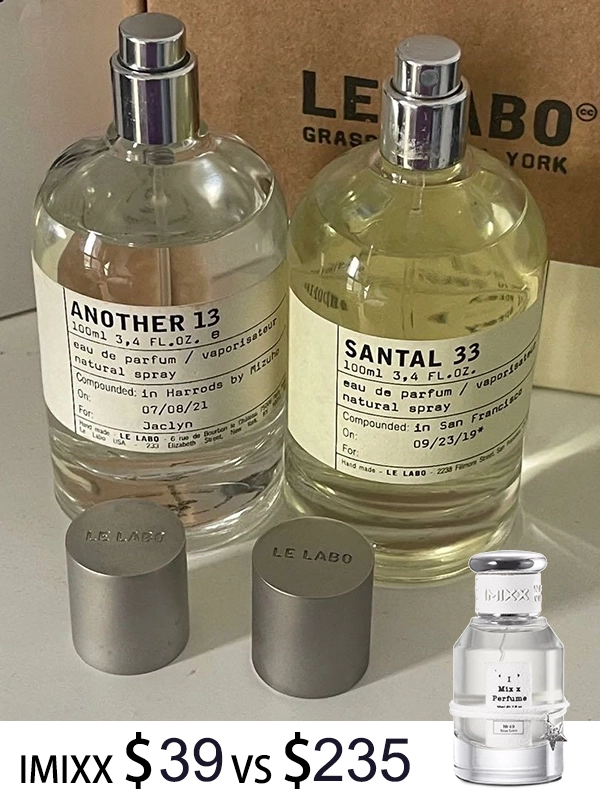
What Makes Santal 33 So Unique? 5 Key Features To Know Before Buying
I built this guide to answer a straightforward question: what actually makes Santal 33 distinctive, and what should you know before spending money on it? Rather than repeating fragrance-blog claims or presenting subjective impressions as facts, I separate Le Labo’s published fragrance description from the sensory interpretations that can vary from one wearer to another.
If you are specifically researching a lower-cost inspired interpretation rather than Le Labo’s original fragrance, my santal 33 page covers the IMIXX interpretation. I want to make that distinction explicit: the IMIXX product is an inspired-by fragrance and is not the original Le Labo product or an item made, licensed, or endorsed by Le Labo.
A major source of online confusion is the accidental merging of two different Le Labo names: Santal 33 and Another 13. They are separate fragrances with different olfactory identities. The official description of Santal 33 centers on cardamom, iris, violet, Australian sandalwood, cedarwood, plus spicy, leathery and musky facets. You can verify that directly on Le Labo’s official Santal 33 product page.
Another 13, by contrast, is described by Le Labo around ambroxyde, jasmine and moss. The official description can be checked on Le Labo’s Another 13 page. I therefore do not treat ambroxyde, jasmine, moss or an invented “Santal 13” identity as defining characteristics of Santal 33.
That correction changes the entire buying discussion. Santal 33 is not a light ambroxyde-centered skin scent under another name. It is better understood as a dry, smoky, woody fragrance whose tension comes from aromatic spice, powdery floral facets, sandalwood, cedarwood, leather-like darkness and musk. That contrast is the reason it can smell comforting to one person, austere to another, and unexpectedly sharp or vegetal to someone else.
I also avoid promising an exact number of hours of longevity. Performance claims such as “8–12 hours” can sound precise while hiding large differences in application, climate, skin condition, spray quantity, fabric, olfactory fatigue and individual perception. I would rather explain what can be verified, what is subjective, and how I recommend testing it before purchasing a full bottle.
Quick Answer: What Is Santal 33 Supposed to Smell Like?
At a high level, I describe Santal 33 as a dry woody fragrance with spicy, smoky, leathery, musky and softly floral contrasts. Cardamom provides aromatic lift. Iris and violet contribute a cool, slightly powdery quality rather than turning the fragrance into a conventional floral perfume. Australian sandalwood and cedarwood establish its woody structure, while leathery and musky nuances make the drydown darker and more textural.
The important phrase here is “I describe.” Smell language is interpretive. Le Labo publishes a creative description and identifies characteristic materials or notes, but individual noses do not necessarily translate those materials into the same associations. One person may emphasize creamy wood; another may perceive dry pencil-like cedar, smoke, worn leather, clean musk, dust, herbs or even a pickle-like nuance. Those responses should be treated as perceptions rather than extra ingredients magically appearing in the formula.
| Question | Evidence-based answer |
|---|---|
| Is Santal 33 a real Le Labo fragrance? | Yes. It is part of Le Labo’s fragrance range. |
| Is “Santal 13” a Le Labo fragrance? | It is not listed in Le Labo’s current Classic Collection. The name commonly reflects confusion between Santal 33 and Another 13. |
| What does Le Labo highlight in Santal 33? | Cardamom, iris, violet, Australian sandalwood, cedarwood, and spicy, leathery and musky facets. |
| Is ambroxyde the defining idea? | No. Ambroxyde is central to Le Labo’s description of Another 13, not its description of Santal 33. |
| Can I rely on a fixed longevity number? | I would not. Longevity and projection vary enough that skin testing is more useful than a universal hour count. |
1. The Cardamom, Iris and Violet Opening Creates Tension Instead of Simple Freshness
The first feature I would pay attention to is the way Santal 33 combines aromatic spice with cooler floral effects. That matters because many woody perfumes introduce their woods through citrus, sweetness or heavy resin. Here, cardamom, iris and violet create a drier and more unusual entrance.
Why cardamom matters
Cardamom can read aromatic, cool, spicy and slightly green. In this composition it helps prevent the woody structure from feeling flat. I do not interpret the opening as a bright citrus splash or a conventional “fresh” fragrance. Instead, it has a restrained aromatic sharpness that creates space around the denser woods underneath.
That contrast is important to the identity of the perfume. If Santal 33 were simply sandalwood plus leather, it could become thick and predictable. The aromatic opening makes the composition feel more angular. It introduces a sense of dryness before the warmer and smokier materials have completely settled.
Iris and violet add texture rather than a bouquet
Iris and violet are also easy to misunderstand when reading a note list. Seeing floral terminology does not mean the perfume will smell like a sweet bouquet. In this context, I think of those facets more as texture: coolness, softness, powder and a muted floral haze around the woods.
This is one reason I recommend smelling the fragrance instead of buying solely from a list of notes. A list tells you which ideas are important to the composition, but it does not tell you their proportions or exactly how your brain will interpret the resulting accord. Someone who says “I dislike floral perfume” could still enjoy this structure because the floral effects are integrated into a distinctly woody composition.
A perfume note is not necessarily a literal raw material or an isolated smell that appears independently. Notes are useful descriptions of an olfactory effect. I use them as a map, not as a complete chemical formula.
2. The Sandalwood and Cedarwood Core Is Dry, Smoky and More Complex Than “Creamy Wood”
The second defining feature is the woody core. The name naturally directs attention toward sandalwood, but focusing on sandalwood alone misses part of the composition. Le Labo also identifies cedarwood and describes the combination as a smoking wood alloy.
That framing explains why I would not classify the fragrance as simply soft or creamy. Sandalwood can create warmth, smoothness and a rounded woody effect, while cedar can feel drier, sharper and more structural. Put together with spice, leather and musk, the result has more friction than the name “Santal” might suggest.
Why the wood can feel smoky without smelling like a bonfire
“Smoky” in fragrance does not have to mean that the perfume smells exactly like burnt wood or ash. I use the word here to describe the darker, charred impression created by the overall woody and leathery structure. The brand itself uses imagery of an open fire and drifting smoke, which is helpful as a creative reference but should not be mistaken for a laboratory breakdown of the formula.
On skin, different wearers may emphasize different sides of this structure. Warm skin, environmental temperature and the amount applied can all change what is most noticeable to the wearer. Fabric can also hold fragrance differently from skin. That is one reason a jacket sprayed yesterday may reveal a different dry woody facet from what you remember smelling during the first hour on your wrist.
The dryness is part of the signature
I consider dryness one of the most useful descriptors for prospective buyers. If you want a syrupy sandalwood, a gourmand vanilla-wood fragrance or a strongly sweet amber, this may not satisfy that expectation. Its personality comes from a more austere balance of wood, aromatic spice, floral powder, leather and musk.
That dryness also helps explain why the fragrance can work across different wardrobes and personal styles. It is not tightly tied to dessert-like sweetness, a conventional masculine fougère structure or a traditionally feminine floral bouquet. The smell itself can therefore feel stylistically flexible even when its signature remains recognizable.
3. Leather and Musk Give the Fragrance Its Worn-In, Textural Character
The third feature I would focus on is the interaction between the wood and the leathery-musky background. This is where Santal 33 develops much of its tactile character. Rather than smelling like freshly cut timber alone, the composition suggests materials that have been handled, warmed and lived with.
Leather is particularly important because it can pull a sandalwood perfume away from polished creaminess. Depending on your perception, it may contribute dryness, darkness, smoke or something slightly animalic. Musk can then soften or extend that effect, helping the fragrance move from an obvious opening toward a more blended drydown.
Why it is commonly treated as gender-flexible
I do not think a fragrance needs to be divided into rigid “for men” and “for women” categories to be useful to shoppers. Santal 33 illustrates why. Its recognizable elements—wood, spice, violet-like powder, leather and musk—do not inherently require one gender identity.
A person who normally wears floral fragrances may find its powdery violet and iris effects familiar. Someone who prefers woody or leathery scents may focus on sandalwood, cedar and the darker drydown. Another wearer may simply read the entire composition as minimalist, urban or outdoorsy rather than masculine or feminine.
For buying purposes, that makes personal taste more relevant than a gender label. I would ask whether you enjoy dry woods, aromatic spice, leather-like texture and restrained sweetness. Those questions predict compatibility far better than asking whether the bottle is marketed toward your gender.
Le Labo Santal 33
Identity: Dry, spicy, woody, smoky, leathery and musky.
Brand-highlighted facets: Cardamom, iris, violet, Australian sandalwood and cedarwood.
Best reason to choose it: You want the original composition, branding and full Le Labo ownership experience.
IMIXX Santal 33-Inspired Fragrance
Identity: An independent fragrance intended for shoppers interested in a similar scent direction.
Important distinction: It is not Le Labo Santal 33 and should not be represented as the original.
Best reason to consider it: You prioritize an inspired scent profile and a different price/value proposition over owning the original product.
4. Its Performance Is Noticeable, but Skin Chemistry Makes Exact Promises Unreliable
The fourth key feature is less about a particular note and more about how the fragrance behaves. Santal 33 has a reputation for being recognizable and persistent, but I would not convert that reputation into a universal claim such as “it lasts exactly 10 hours.” That level of certainty is not justified without a controlled test, and even controlled testing would not guarantee the same result for every wearer.
Why fragrance longevity varies
Several variables change perceived performance. The number of sprays obviously matters. So does where the perfume is applied. A fragrance sprayed onto fabric may remain detectable longer than the same fragrance on skin. Dry skin may behave differently from moisturized skin. Heat can increase diffusion, while cold conditions can make a fragrance appear quieter. Heavy airflow changes the scent cloud around you, and repeated exposure can cause your own nose to become less responsive even while other people can still smell the fragrance.
This last point is especially important. When someone says, “My perfume disappeared after two hours,” that does not always mean the fragrance has physically vanished. Olfactory adaptation can make a familiar smell less obvious to the person wearing it. For that reason, I do not recommend repeatedly adding sprays every time you stop noticing your perfume.
How I recommend evaluating performance
I prefer a simple controlled wear test. Start with clean skin and avoid applying another strongly scented body product in the same area. Use a consistent number of sprays. Check the fragrance at approximately 15 minutes, one to two hours, four hours and later in the day. Do not keep your wrist directly under your nose for long periods; move normally and return to it periodically.
I would evaluate three separate dimensions:
- Longevity: How long can you still detect the fragrance?
- Projection: How far from your body does it appear noticeable during the early and middle stages?
- Sillage: What kind of scent trail does it seem to leave as you move?
Those concepts are related but not identical. A fragrance can last a long time close to the skin without projecting dramatically. Conversely, something may project strongly at first and then become quiet relatively quickly. Treating performance as a single number loses those distinctions.
| Test stage | What I would evaluate | Why it matters |
|---|---|---|
| First 15 minutes | Aromatic spice, initial intensity, immediate associations | Shows whether the opening itself is pleasant to you. |
| 1–2 hours | Balance of floral dryness, sandalwood, cedar and leather | Often more representative of the fragrance you will actually wear for much of the day. |
| 4+ hours | Remaining woods, musk, softness and proximity to skin | Helps determine whether you like the drydown enough to justify a full bottle. |
| Next-day fabric check | Residual woody or musky character | Useful for understanding persistence on clothing, although it does not equal skin performance. |
5. Santal 33 Is Distinctive Because It Is Recognizable and Polarizing at the Same Time
The fifth feature is the one I think matters most before buying: Santal 33 has a strong identity. That does not mean everyone will interpret it the same way or enjoy it. In fact, part of its recognizability comes from a structure that can be polarizing.
Some wearers interpret the woody-spicy profile as smooth, sophisticated and comforting. Others find it dry, sharp or medicinal. A frequently discussed subjective association is something dill- or pickle-like. I treat that description carefully because it is a sensory association, not an official note declaration. If your nose makes that connection, however, telling you that the fragrance “does not contain a pickle note” will not make the association disappear.
This is exactly why sampling matters more with a distinctive perfume than with a neutral one. The central question is not whether online reviewers collectively approve of it. The question is whether its specific balance works with your perception and whether you enjoy that balance after the opening has passed.
The more recognizable and polarizing a fragrance is, the less I trust blind-buy recommendations. A sample or skin test gives you information that popularity rankings cannot.
Santal 33 vs. Another 13: The Comparison That Actually Clears Up the Confusion
Because the names are frequently mixed together, I think a direct comparison with Another 13 is more useful than inventing a fragrance between them. They are not versions of the same perfume and they are not differentiated simply by one being “strong” and the other “light.” Their published concepts are fundamentally different.
Santal 33 is presented around cardamom, iris, violet, sandalwood, cedarwood, spice, leather and musk. Another 13 is presented around ambroxyde with jasmine and moss. That makes Another 13 a much more logical reference when somebody is describing an ambroxyde-driven, musky, skin-oriented Le Labo fragrance.
The incorrect pear claim is also worth cleaning up. I do not see pear included in Le Labo’s official description of either fragrance on the product pages referenced in this article. I therefore would not use pear as a verified identifying note simply because it appears in third-party note pyramids or recycled blog copy.
| Characteristic | Santal 33 | Another 13 |
|---|---|---|
| Central idea | Spicy, smoky woods with leathery and musky depth | Ambroxyde-centered musky composition with jasmine and moss |
| Officially highlighted materials/facets | Cardamom, iris, violet, Australian sandalwood, cedarwood, spice, leather, musk | Ambroxyde, jasmine, moss |
| General sensory direction | Dry, woody, aromatic, smoky and textured | Musky, abstract, cleaner and more skin-scent oriented in concept |
| Are they interchangeable? | No | No |
How Santal 33 Changes From Opening to Drydown
I find it more useful to discuss fragrance development in stages than to pretend every perfume follows an exact three-level pyramid. On actual skin, stages overlap. What you perceive depends on volatility, concentration, application and your own sensory attention.
Opening: aromatic, dry and immediately distinctive
The cardamom effect is one of the first ideas I would look for. Instead of a juicy citrus introduction, the fragrance begins in an aromatic, dry direction. Iris and violet can contribute cool powder or a slightly smooth cosmetic texture, but the woods are never far away.
Middle: the woods become the structural center
As the opening settles, the relationship between sandalwood and cedar becomes easier to evaluate. This is the stage I consider most important for a purchase decision because the fragrance begins to reveal the character you will live with after the first impression.
If you enjoy dry sandalwood, cedar, gentle smoke and leather, this stage is likely to explain the fragrance’s appeal. If the structure feels too sharp, too austere or produces an unwanted vegetal association for you, waiting another few hours is still worthwhile—but I would not assume the entire personality will reverse.
Drydown: softer woods, musk and a more intimate texture
Later, I would expect the most volatile aromatic effects to become quieter while the woody, leathery and musky impression feels more blended. Exactly how strong that base remains will vary with application and wearer.
This is why I recommend keeping a sample on for a complete wearing rather than judging it from a paper strip in the first five minutes. Blotters are useful for comparison, but skin adds heat, moisture and a personal wearing environment that can change perception.
Who Is Santal 33 Best For?
I would place it on a shortlist for someone who values recognizable woody fragrances and does not need sweetness to make a perfume feel luxurious. It is especially worth sampling if you enjoy sandalwood, cedar, cardamom, dry floral textures, leather or musk.
You may enjoy it if…
- You like dry, woody fragrances.
- You enjoy cardamom and aromatic spice.
- You prefer moderate sweetness rather than gourmand effects.
- You like leather and musk as supporting textures.
- You want something with a recognizable scent identity.
- You are comfortable with a fragrance that can attract strong opinions.
You should sample first if…
- You strongly dislike dry cedar-like effects.
- You want a sweet or creamy vanilla sandalwood.
- Leather notes often become harsh on your skin.
- You are sensitive to powerful woody fragrances.
- You have previously noticed an unpleasant dill-like association in similar scents.
- You are considering an expensive blind buy based mainly on popularity.
Is Santal 33 an Everyday Fragrance?
It can be, but I would not automatically label it “perfect for everyday wear.” That phrase is too generic to help someone make a purchase. Everyday suitability depends on how much you apply, where you work, whether people around you are fragrance-sensitive and how prominently the scent projects from your skin.
For casual wear, the dry woody structure can be easy to pair with a broad range of settings because it does not depend on a formal, heavily sweet or overtly romantic theme. For office wear, restraint matters more. A fragrance can be personally enjoyable and still be disruptive when heavily sprayed in a shared indoor environment.
For evenings, Santal 33 has enough smoke, leather and musk to avoid feeling overly clean or purely functional. At the same time, it is not a syrupy “night out” fragrance. I see that ambiguity as one of its strengths: it does not require a specific dress code to make sense.
What About Seasons?
I am cautious about rigid seasonal rules. Fragrance does not become unusable because the calendar changes. However, temperature influences diffusion and perception, so adjusting application can make a meaningful difference.
In cooler weather, the woody and leathery facets may feel especially natural, and you may find yourself comfortable with a normal application. In high heat, I would begin with less because warmth can increase how quickly fragrance moves into the surrounding air. The goal is not to force the perfume into a seasonal category but to control intensity for the environment.
| Situation | My approach |
|---|---|
| Cool weather | A normal skin test lets the woody and leathery structure develop without assuming cold automatically makes it weak. |
| Warm weather | Start conservatively and evaluate projection before adding more. |
| Office or classroom | Use a restrained application and consider fragrance policies and nearby people. |
| Outdoor use | Air movement may make the scent seem less concentrated than it does indoors. |
Original Santal 33 vs. an Inspired Interpretation: How I Would Decide
I do not think the decision should be framed as “which one is secretly the same product?” An inspired fragrance and the original are separate products. Even when they aim for a related scent direction, differences can appear in raw materials, concentration, transitions, texture, packaging, brand experience and batch-to-batch perception.
If your priority is owning the original composition and Le Labo presentation, the authentic fragrance is the logical choice. If your priority is exploring a similar woody-spicy aesthetic at a different price point, an inspired interpretation may make more sense. Neither decision requires pretending that the products are identical.
I recommend evaluating the aspects that matter most to you:
- Scent fidelity: Which specific parts of the original experience are most important to you?
- Drydown: Does the alternative remain convincing after the opening disappears?
- Performance: How does each option behave on your own skin under comparable application?
- Budget: Are you buying fragrance mainly for scent experience or also for the original brand and presentation?
- Frequency of use: A bottle you confidently wear several times per week may offer better practical value than a prestigious bottle you rarely reach for.
IMIXX sells an inspired interpretation of this scent direction. I distinguish that commercial offering from factual information about Le Labo’s original product throughout this guide. An inspired fragrance should be presented as an inspired fragrance—not as Le Labo merchandise.
How to Test Santal 33 Before Buying a Full Bottle
For a fragrance this distinctive, I think a deliberate test is more useful than reading another dozen reviews. Reviews can tell you what associations other people experienced, but they cannot tell you exactly how your nose and skin will respond.
Step 1: Smell it on paper first
A blotter gives you a relatively neutral first look at the fragrance and makes side-by-side comparisons easier. I would note the initial spice, dryness, woods and any unusual association that appears immediately.
Step 2: Move to skin
If the blotter interests you, test one or two sprays on clean skin. Avoid layering a strong lotion, soap or another perfume under the test area because that makes the result harder to interpret.
Step 3: Stop smelling it continuously
Constantly placing your nose against the test area can accelerate olfactory fatigue. I prefer checking periodically while going about the day normally. This also provides a more realistic sense of the scent cloud you encounter through movement.
Step 4: Evaluate the drydown, not just the opening
The first few minutes are only part of the purchase. If you love the opening but dislike the woody-musky base four hours later, you are unlikely to enjoy owning the fragrance. The reverse can also happen: a strange opening may develop into a drydown you find much more compelling.
Step 5: Repeat on a different day
One wearing can be distorted by weather, mood, other smells in the environment or simple sensory fatigue. If the bottle represents a significant purchase for you, I would test it twice before making a decision.
Fragrance Sensitivity: A Practical Point That Buying Guides Often Ignore
Perfume is a cosmetic product, and fragrance ingredients can trigger irritation, sensitivity or allergic reactions in some people. The U.S. Food and Drug Administration notes that cosmetic products, including fragrances, can provoke allergic reactions and recommends reviewing ingredient information if you know you are sensitive to particular substances. Its current guidance is available on the FDA cosmetics allergen information page.
I therefore would not describe any fragrance as universally “skin-safe,” “non-irritating” or suitable for every sensitive user. If you already know that fragrance causes dermatitis or respiratory symptoms for you, ingredient-level medical questions are more important than whether a scent has good reviews.
Also remember that a fragrance’s published “notes” and its ingredient declaration serve different purposes. A note list describes the artistic smell profile. An ingredient list deals with composition and labeling. They should not be treated as interchangeable documents.
What Makes Santal 33 Worth the Price—or Not?
Value is more complicated than asking whether a fragrance “smells expensive.” I would divide value into scent value, ownership value and usage value.
Scent value asks whether you genuinely like the composition enough to choose it over other fragrances. Ownership value includes the original bottle, presentation, brand experience and confidence that you own the authentic product. Usage value asks how frequently you will actually wear it.
If you love the exact original composition and care about owning the authentic Le Labo bottle, an inspired interpretation cannot reproduce the ownership value because it is a different product. If your goal is primarily a related scent experience while controlling cost, the calculation changes.
This is why I resist universal statements such as “Santal 33 is worth it” or “Santal 33 is overpriced.” Both claims ignore the buyer. A person who wears the fragrance 150 days a year may evaluate its value very differently from someone who enjoys it twice a month.
Five Key Features at a Glance
| Feature | What it contributes | What to consider before buying |
|---|---|---|
| 1. Cardamom, iris and violet contrast | Aromatic spice and cool, softly powdery texture. | Do you enjoy dry spice more than bright citrus or sweetness? |
| 2. Sandalwood and cedarwood structure | Dry, smoky woody identity with both smooth and structural facets. | Do you want dry wood, or are you expecting a sweet creamy sandalwood? |
| 3. Leather and musk | Adds darkness, texture and a worn-in character. | Leather can become sharper or more prominent on some wearers. |
| 4. Variable performance | Can remain recognizable for a substantial wear, but results vary. | Test longevity and projection on your own skin instead of trusting a fixed hour claim. |
| 5. Strong signature | Makes the fragrance memorable and easy to identify for many wearers. | A recognizable profile can also be polarizing, so sampling is particularly useful. |
My Research Standard for This Guide
I want the distinction between evidence and interpretation to remain visible rather than burying it in fine print. For product identity and the official scent description, I prioritize Le Labo’s own current product information. That is why I identify Santal 33 and Another 13 as separate products and why I do not repeat the nonexistent “Santal 13” claim.
I also do not treat third-party note pyramids as automatically more authoritative than the brand’s published description. Fragrance databases and community reviews can be useful for discovering how other people perceive a scent, but they are not substitutes for primary-source product identification.
For sensory descriptions such as “dry,” “powdery,” “smoky” or “worn-in,” I present them as interpretation. They help translate a note list into understandable language but should not be confused with laboratory measurements.
For performance, I avoid inventing precision. Without a disclosed testing protocol, statements such as “lasts exactly eight to ten hours” are not robust evidence. A better approach is to explain why performance differs and give you a repeatable testing method.
Finally, I separate commercial information from editorial information. IMIXX offers an inspired product, but that does not change what the original Le Labo fragrance is. Keeping those identities separate is essential if a buying guide is supposed to help rather than funnel every question into a purchase.
FAQ: Santal 33
What does Santal 33 smell like?
I describe it as a dry, spicy, smoky woody fragrance with cool floral texture and leathery-musky depth. Le Labo specifically highlights cardamom, iris, violet, Australian sandalwood, cedarwood, plus spicy, leathery and musky facets. Individual wearers can perceive those elements differently.
Is Santal 13 a real Le Labo perfume?
I do not find a Santal 13 in Le Labo’s current Classic Collection. The name appears to result from mixing up Santal 33 with Another 13. They are two separate fragrances and should not be combined into a fictional product.
Is Santal 33 the same as Another 13?
No. Santal 33 is built conceptually around aromatic spice, floral facets, sandalwood, cedarwood, leather and musk. Another 13 is described by Le Labo around ambroxyde, jasmine and moss. Their names, concepts and scent profiles are distinct.
Is Santal 33 masculine or feminine?
I would judge it by scent preference rather than gender. Its dry woods, spice, violet-like powder, leather and musk can appeal across traditional fragrance categories. If those facets suit your taste, a gender label adds little useful information.
How long does Santal 33 last?
I would not promise one universal number. Longevity depends on spray quantity, skin, fabric, climate, activity and perception. Test a consistent application over a full day and judge both projection and close-to-skin longevity rather than relying on a fixed online estimate.
Why do some people describe Santal 33 as pickle-like?
That description is a subjective scent association rather than an official note. Certain wearers interpret the dry, aromatic woody profile in a dill- or pickle-like direction. Other people do not perceive that association at all, which is one reason I strongly recommend sampling it on skin.
Is Santal 33 good for everyday wear?
It can be. Its woody profile is versatile, but application matters. For offices, classrooms and shared spaces, I would start conservatively rather than assuming a fragrance that works casually is automatically appropriate at high projection.
Should I blind buy Santal 33?
I would sample it first whenever possible. Its strong woody signature is part of what makes it memorable, but that same individuality creates polarized reactions. A complete skin wearing tells you more than popularity, ratings or a note list.
What is the difference between authentic Santal 33 and an inspired fragrance?
The authentic product is Le Labo’s original fragrance and carries its formulation, branding and presentation. An inspired fragrance is a separate product designed around a related scent direction. I recommend comparing them on scent, drydown, performance, price and ownership priorities without describing the inspired product as the original.
Is Santal 33 sweet?
I would not classify sweetness as its defining trait. Its personality leans toward dry woods, aromatic spice, leather, musk and cool floral texture. Anyone specifically seeking a sugary gourmand or vanilla-heavy sandalwood should sample before assuming the name “sandalwood” implies a creamy sweet scent.
Final Verdict: What Really Makes Santal 33 Unique?
For me, the answer is not a fictional note list, an unsupported celebrity endorsement or an exact longevity number. The identity of Santal 33 comes from the tension between cardamom, iris and violet on one side and sandalwood, cedarwood, leather and musk on the other. It is dry yet comforting, woody yet not purely naturalistic, softly powdery yet far from a conventional floral perfume.
Its recognizability is both an advantage and a warning. If that particular woody-spicy signature works for your nose, it can feel unusually coherent and memorable. If your nose turns the same structure toward harsh cedar, medicinal dryness or a dill-like association, popularity will not make the perfume more enjoyable.
That is why my most useful recommendation is simple: verify what the product actually is, separate official information from subjective description, sample it through the drydown, and decide based on your own response. If you want the original Le Labo experience, buy the original from a trustworthy source. If you want an inspired interpretation at a different price point, evaluate that product openly as a separate fragrance.
That distinction makes the buying decision clearer, more accurate and much more useful than treating every Santal-related name as if it were interchangeable.

